Power Station for Camping and Fishing: Sizing Your Gear
Short answer
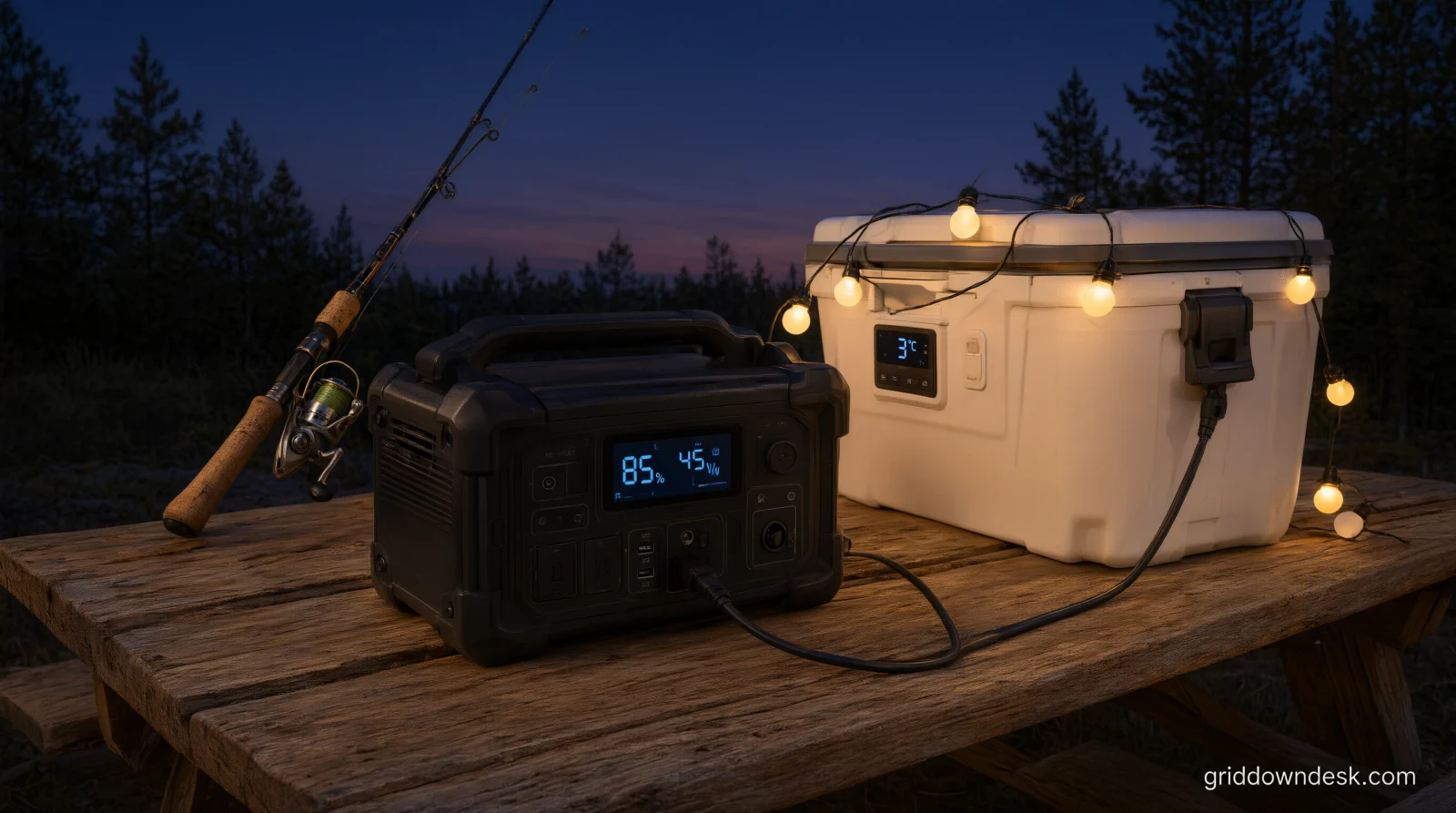
For a weekend camping or fishing trip with a 12V compressor cooler, LED string lights, and device charging, a 500Wh portable power station is usually sufficient. For extended off-grid trips over 3 days, aim for 1000Wh or pair a smaller station with a 100W foldable solar panel to recharge daily.
Why outdoor power needs are different
Powering gear in a garage, at a campsite, or on a boat is fundamentally different from powering a home office. Outdoors, you deal with dust, moisture, temperature extremes, and the critical need to maximize every watt-hour of battery capacity.
The biggest advantage outdoors is the ability to use DC (Direct Current) power. Most camping gear, especially 12V compressor coolers and LED lights, runs natively on 12V DC. By plugging these directly into the power station's 12V car socket (cigarette lighter port), you bypass the internal AC inverter. This eliminates the 10-15% energy loss that occurs when converting DC battery power to AC wall power, significantly extending your runtime.
Typical outdoor gear wattage
Before buying a station, add up the power draw of the gear you plan to bring. Here are the realistic average draws for popular outdoor equipment:
| Outdoor Gear | Typical Wattage | Connection Type |
|---|---|---|
| 12V Compressor Cooler (running) | 35 – 45 W | 12V DC |
| 12V Compressor Cooler (startup surge) | 100 – 150 W | 12V DC |
| LED String Lights (10m) | 8 – 12 W | 12V DC or USB |
| Electric Fish Finder | 15 – 25 W | 12V DC |
| Drone Battery Charging (60W charger) | 60 W | AC or USB-C |
| Smartphone Charging | 10 – 18 W | USB-C |
| Portable Electric Grill | 800 – 1200 W | AC Only |
Notice the electric grill at the bottom. High-wattage heating elements are the enemy of portable battery capacity. A 1000Wh station will run a 1000W grill for less than 45 minutes. For cooking outdoors, propane or charcoal remains vastly more efficient.
The calculation for a weekend trip
Let's calculate the energy needed for a standard 48-hour fishing trip.
The load:
- 12V Compressor cooler: runs 30% of the time (duty cycle) at 40W. Average draw = 12W. Over 48 hours = 576Wh.
- LED string lights: 10W for 6 hours each night (12 hours total) = 120Wh.
- Charging 2 smartphones and 1 drone battery: ~150Wh total.
Total estimated consumption: 576 + 120 + 150 = 846Wh.
A 500Wh station will not cover this alone. However, if you bring a 100W solar panel and get 4 peak sun hours per day, you will generate roughly 300-350Wh per day (accounting for angle and efficiency). Over two days, that adds 600-700Wh, making a 500Wh station perfectly viable for the trip.
Environmental factors that reduce capacity
Manufacturer ratings are tested in perfect laboratory conditions (usually 25°C / 77°F). The outdoors is rarely perfect.
Cold weather: Lithium batteries (both NMC and LiFePO4) lose capacity in the cold. At 0°C (32°F), expect a 20-30% reduction in usable capacity. Some advanced stations include battery heating pads that use grid or solar power to warm the cells before charging, but they do not eliminate the discharge loss.
Hot weather: High ambient temperatures force your 12V cooler to work harder. If the outside temperature rises from 20°C to 35°C, the cooler's duty cycle can jump from 30% to 60%, doubling its energy consumption. Keep your cooler in the shade and cover it with a reflective blanket.
Dust and Moisture: Check the IP rating of your power station. An IP65 rating means it is dust-tight and protected against low-pressure water jets, making it safe for beach fishing or rainy campsites. An IP20 rating (common in indoor-focused stations) means it must be kept inside a tent or vehicle.
For more details on recharging off-grid, see our guide on how to calculate solar panel needs.
FAQ
Can I charge the power station in my car while driving? Yes, using the 12V car charging cable. However, car alternators typically provide 100W to 150W of charging power. It is much slower than AC wall charging and will take 5-8 hours to fully charge a 500Wh station. It is best used as a top-up while driving to the campsite.
Will the compressor cooler's startup surge trip the power station? Most modern power stations have a surge capacity 2x their continuous rating. A 500W station can handle a 1000W surge for a few seconds. Since a 12V cooler only surges to 150W, it will not trip even a small 300W station, provided you use the 12V DC port.
Is it safe to leave the power station outside overnight? Only if it has a high IP rating (IP65 or higher) and the temperature stays within the manufacturer's operating range (usually 0°C to 40°C). Condensation can form inside the unit if temperatures drop rapidly at night, which can damage the electronics. It is always safer to store it inside a tent or vehicle.
Can I use a power station to jump-start my car or boat? Only if it has a dedicated 12V jump-start port and the manufacturer explicitly states it supports this function. Do not attempt to jump-start a vehicle using the standard 12V cigarette lighter socket, as it will blow the internal fuse or damage the battery management system.