Oxygen Concentrator Battery Backup Guide
Short answer
To safely power a home oxygen concentrator during a blackout, you need a portable power station or inverter system with a pure sine wave output and a continuous wattage rating of at least 600W to 1000W. A typical stationary concentrator draws 300W to 600W. A 1000Wh portable power station will provide approximately 1.5 to 2.5 hours of runtime, while a 2000Wh unit can sustain the device for 3 to 5 hours.
Why standard UPS systems are not enough
Many people assume a standard computer UPS will keep an oxygen concentrator running. This is a dangerous misconception.
First, oxygen concentrators contain a compressor and a sieve bed that require a continuous, high-wattage draw (often 300W–600W). A typical 600VA UPS only has about 80-100Wh of battery capacity and will shut down in 10 to 15 minutes. Second, the compressor motor is highly sensitive to power quality. A cheap "modified sine wave" inverter will cause the motor to overheat, buzz loudly, and potentially fail, cutting off the patient's oxygen supply.
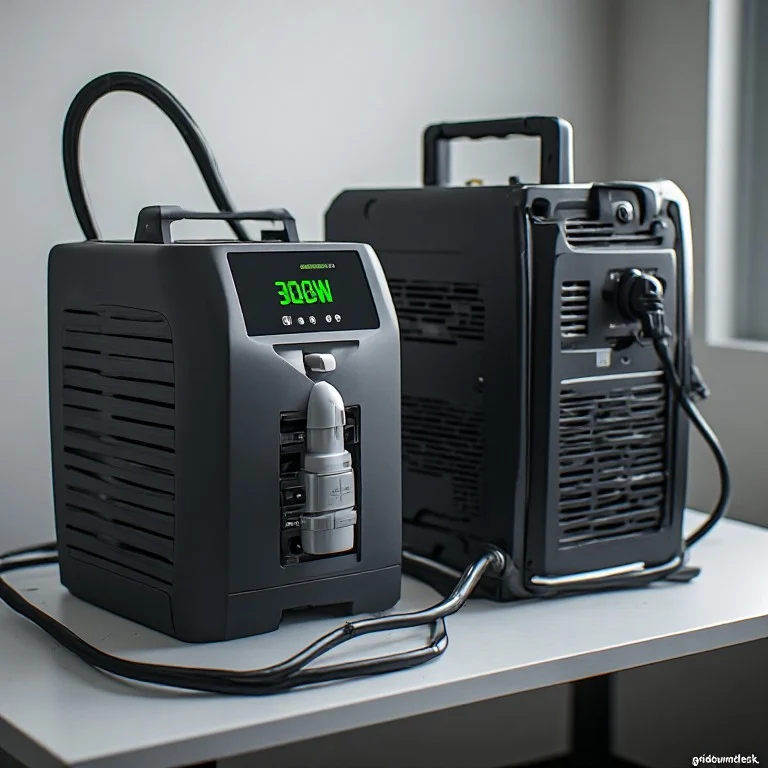
Understanding concentrator power consumption
Power draw varies significantly based on the type of machine and the prescribed oxygen flow rate (Liters Per Minute, or LPM).
Typical power consumption:
- Portable Oxygen Concentrator (POC): 40W to 60W (on pulse dose setting).
- Stationary Concentrator (1-3 LPM): 250W to 350W.
- Stationary Concentrator (5+ LPM): 450W to 600W.
- Compressor startup surge: Can briefly spike to 800W–1000W for a fraction of a second.
Always check the manufacturer's label on the back of the specific machine for the "Input Power" or "Max Wattage" to get the exact number.
Calculating your required battery capacity
To determine how long your concentrator will run, use the standard runtime formula. For a deeper dive into this math, see our guide on UPS runtime explained: VA vs watt-hours.
Runtime (hours) = (Battery Capacity in Wh × Inverter Efficiency) ÷ Concentrator Wattage
Note: We use 0.85 for inverter efficiency to account for the energy lost when converting DC battery power to AC wall power.
Example Calculation:
- You have a 2000Wh portable power station.
- Your stationary concentrator draws 400W continuously at 3 LPM.
- Usable energy: 2000 × 0.85 = 1700 Wh.
- Runtime: 1700 ÷ 400W = 4.25 hours.
If you need longer runtime, you must either upgrade to a larger power station (e.g., 3000Wh+) or connect external expansion batteries if your model supports them.
Critical requirements for medical backup
- Pure Sine Wave is Mandatory: As stated, modified sine wave will damage the compressor. Ensure the product specifications explicitly state "Pure Sine Wave Output."
- Surge Capacity: The power station's peak/surge wattage rating must be higher than the concentrator's startup spike (usually at least 1000W–1200W surge capacity).
- LiFePO4 Battery Chemistry: For medical devices, reliability is paramount. Lithium Iron Phosphate (LiFePO4) batteries are safer, more stable, and last for 3000+ cycles, ensuring the unit will be ready when an emergency strikes. For long-term care tips, refer to our guide on how to maintain and store your portable power station.
Safety protocols and best practices
- Test the setup in advance: Never wait for a blackout to test your equipment. Plug the concentrator into the power station while the patient is awake and supervised to ensure the machine runs smoothly without error codes or unusual noises.
- Keep the station ventilated: While lithium power stations do not emit carbon monoxide (unlike gas generators), they do have cooling fans that vent heat. Keep the unit in a well-ventilated room, at least 1 foot away from walls or curtains.
- Have a backup plan: Battery estimates are just that—estimates. Always have a backup plan, such as a secondary fully charged power station, or a connection to a medical alert service that can prioritize your home for grid restoration.
- Consult your doctor: Discuss your backup power plan with your healthcare provider. They may be able to provide specific guidance based on the patient's exact oxygen needs and the specific model of the concentrator.
FAQ
Can I use a car battery and inverter for my oxygen concentrator? Yes, but only if the inverter is a high-quality pure sine wave model rated for at least 1000W continuous. A standard car battery will drain quickly, so a deep-cycle marine or LiFePO4 battery is highly recommended for repeated use.
Will the concentrator work if the power station battery drops to 10%? Most modern power stations will shut off output at around 5-10% to protect the battery cells from permanent damage. Do not rely on the last 10% of the battery. Plan to recharge or swap batteries before reaching this level.
Can I run the concentrator and a CPAP machine on the same power station? Yes, if the power station's continuous wattage rating exceeds the combined draw of both devices, plus a 20% safety margin. For example, a 400W concentrator + 60W CPAP = 460W. You would need a power station rated for at least 600W continuous output.
Do portable oxygen concentrators (POCs) need special power? POCs are designed to be highly energy-efficient and often come with a 12V DC car adapter. Using the DC adapter directly with a power station's 12V car port is the most efficient method, as it bypasses the AC inverter entirely, extending runtime by 15-20%.