Sump Pump Battery Backup: Sizing & Runtime Guide
Short answer
To reliably power a standard submersible sump pump during a storm-induced blackout, you need a portable power station with a pure sine wave inverter, a continuous output of at least 1500W, and a battery capacity of 1000Wh to 2000Wh. This setup can handle the massive startup surge of the pump motor and provide 2 to 5 hours of continuous runtime during heavy rainfall.
Why sump pumps are the ultimate test for backup power
A power outage during a heavy rainstorm is the worst-case scenario for a basement. The grid fails exactly when your sump pump is needed most.
Sump pumps are inductive loads, meaning they contain electric motors. Motors require a massive spike of power (surge wattage) for a fraction of a second to start spinning, often 3 to 5 times higher than their normal running wattage. If your backup power source cannot handle this surge, it will instantly trip its overload protection, leaving your basement vulnerable to flooding.
Real-world power consumption breakdown
Never rely on the "Horsepower (HP)" rating alone. You must look at the actual electrical draw on the pump's nameplate.
Typical power consumption:
- 1/4 HP Sump Pump: 400W running, 1000W – 1200W startup surge.
- 1/3 HP Sump Pump (Most Common): 500W – 800W running, 1500W – 2000W startup surge.
- 1/2 HP Sump Pump: 800W – 1000W running, 2000W – 2500W startup surge.
Additionally, during a heavy storm, the pump's "duty cycle" (the percentage of time it is actively running) can jump from a normal 10-20% to 50-70% or even 100% if the water table is extremely high.
Calculating the runtime during a storm
To estimate how long your power station will last, we use the standard runtime formula, adjusted for the high duty cycle of a storm. For the base math, see our guide on UPS runtime explained: VA vs watt-hours.
Runtime (hours) = (Battery Capacity in Wh × 0.85) ÷ (Running Watts × Duty Cycle)
Example Calculation:
- You have a 2000Wh portable power station.
- Your 1/3 HP pump draws 600W when running.
- During a heavy storm, the duty cycle is 60% (0.60).
- Effective average draw: 600W × 0.60 = 360W.
- Usable energy: 2000 × 0.85 = 1700 Wh.
- Runtime: 1700 Wh ÷ 360W = ~4.7 hours.
If the storm passes and the duty cycle drops to 20%, that same 2000Wh station could theoretically last over 14 hours.
Critical requirements for sump pump backup
- Pure Sine Wave is Non-Negotiable: Inductive motors run hotter and less efficiently on modified sine wave power. A pure sine wave inverter ensures the pump motor runs smoothly, quietly, and without risking premature burnout.
- Surge Capacity Margin: Your power station's peak surge rating must exceed the pump's startup surge by at least 20%. If your pump surges to 1800W, choose a power station with a 2200W+ surge rating.
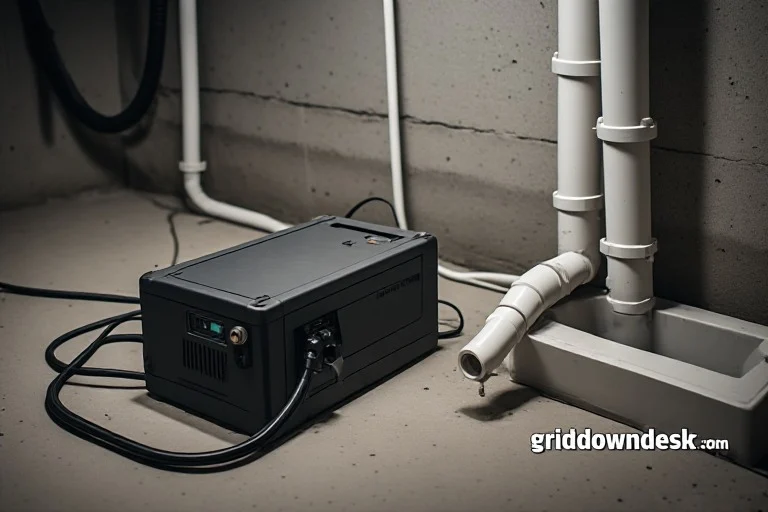
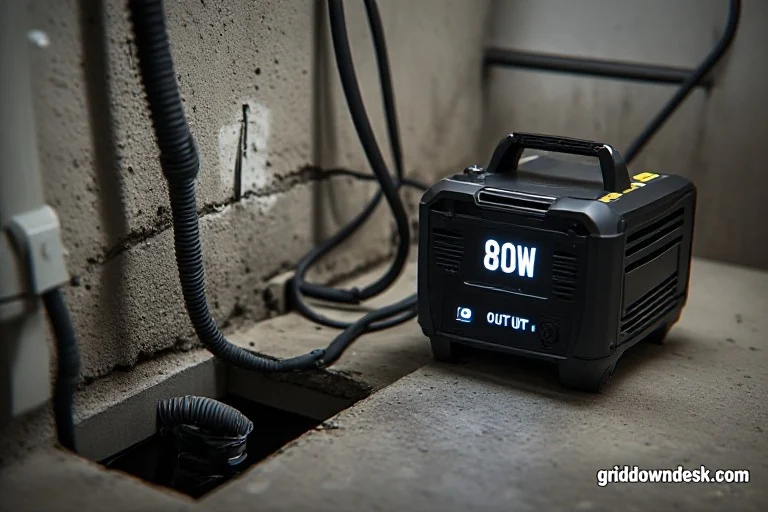
- Elevation and Safety: Never place a power station directly on a wet basement floor. Place it on a sturdy shelf, a wooden pallet, or a plastic crate at least 12 inches off the ground to protect it from minor seepage or splashing.
Alternative: Dedicated Sump Pump Battery Backup Systems
If you do not want to use a portable power station, you can install a dedicated DC sump pump backup system. These systems use a deep-cycle marine or AGM battery and a specialized DC pump (or an inverter designed specifically for sump pumps).
Pros: Automatically switches on when the main pump loses power; designed specifically for this task. Cons: Requires professional plumbing and electrical installation; the battery requires regular maintenance and water level checks (for flooded lead-acid types).
For general electrical safety principles when connecting backup power to home systems, always refer to our guide on safe power station home connection.
Best practices for storm readiness
- Test before the storm: Once a month, unplug your sump pump from the wall and plug it into your powered-on portable power station. Pour a bucket of water into the pit to ensure the pump activates, runs smoothly, and the power station does not trip.
- Keep the station charged: Lithium batteries self-discharge. A power station sitting at 20% charge in the corner of your basement is useless. Check it monthly. For comprehensive battery care instructions, see our guide on how to maintain and store your portable power station.
- Have a manual backup: Keep a wet/dry shop vacuum or a manual hand pump in the basement as a last resort if the primary pump or backup power fails.
FAQ
Can I use a standard home UPS for my sump pump? No. Standard computer UPS units do not have the continuous wattage or the massive surge capacity required to start a sump pump motor. They will trip instantly.
Will the power station recharge from solar during a storm? Unlikely. Heavy storm clouds drastically reduce solar panel output, often to 10-20% of their rated capacity. Do not rely on solar recharging during the peak of a severe storm.
Can I run the sump pump and a refrigerator on the same power station? Yes, but you must add their wattages together, including their surge potentials. A 600W pump + 150W fridge = 750W running. You would need a power station with at least a 1000W continuous output and a 2500W+ surge capacity to handle both safely.
What happens if the power station battery dies while the pump is running? The pump will stop immediately, and water will begin to accumulate in the pit. This is why calculating your runtime conservatively and having a secondary backup plan is critical for basement protection.