Safe Power Station Home Connection Guide
Short answer
The only safe way to connect a portable power station to your home's wiring is through a professionally installed manual transfer switch or an interlock kit. This mechanical barrier physically prevents power from flowing back into the utility grid (backfeeding), protecting line workers from electrocution and preventing catastrophic damage to your home's electrical panel when grid power is restored.
The deadly danger of "backfeeding"
A common and extremely dangerous misconception is that you can simply plug a "double-male" extension cord (often called a suicide cord) from a power station into a dryer or stove outlet to power the house.
Never do this.
If the main breaker is not turned off, the power from your station will flow backward through your home's wiring and into the utility transformer. This steps up the voltage to thousands of volts, creating a lethal hazard for utility workers repairing the lines. Furthermore, when grid power is restored, the collision of two power sources will instantly destroy your power station, your appliances, and potentially cause an electrical fire.
The safe solution: Transfer switches and interlock kits
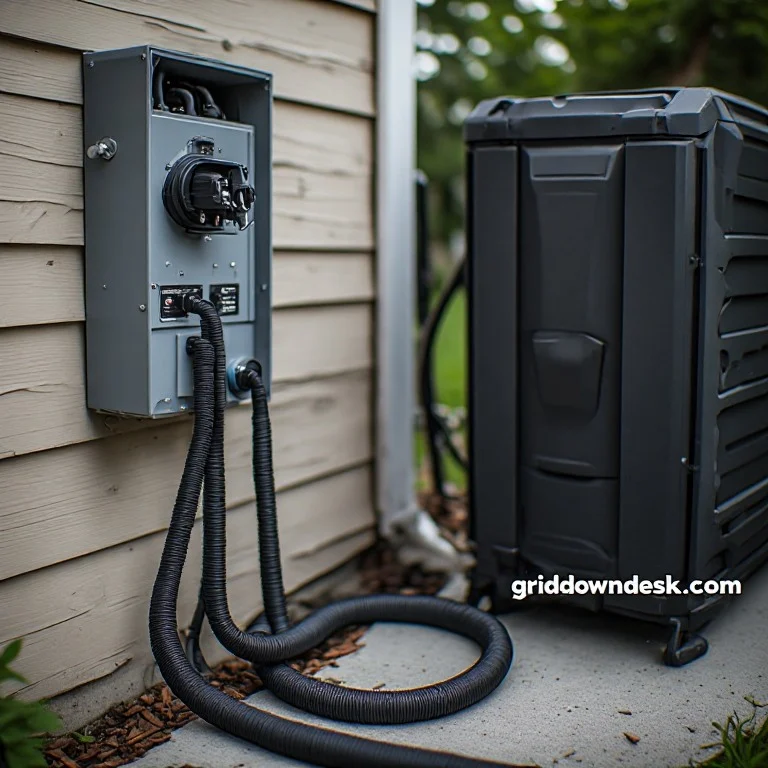
To legally and safely power hardwired home circuits (like a well pump, sump pump, or refrigerator), you must isolate your home from the grid. There are two primary methods:
- Manual Transfer Switch: A sub-panel installed next to your main electrical panel. It contains a mechanical switch that physically disconnects the selected circuits from the utility grid and connects them to an external inlet box, which your power station plugs into.
- Generator Interlock Kit: A metal plate installed on the main panel that physically prevents the main breaker and the generator backup breaker from being in the "ON" position at the same time. This is often more cost-effective but requires an electrician to wire a dedicated backup circuit.
Both methods ensure 100% isolation from the grid, making them the only code-compliant solutions.
Sizing your power station for critical circuits
Before installing a transfer switch, you must know the total wattage of the circuits you plan to back up. A typical power station cannot power an entire home, so you must prioritize.
Critical circuits usually include:
- Refrigerator / Freezer (800W surge, 150W running)
- Sump pump (1500W surge, 800W running)
- Gas furnace blower (400W running)
- Well pump (1000W surge, 400W running)
To calculate your exact load and ensure your power station's inverter can handle the combined surge, refer to our guide on how to calculate your home office power needs (the same measurement principles apply to home appliances).
For example, if your critical circuits draw a maximum of 1500W simultaneously, you must choose a power station with a continuous AC output of at least 1800W to 2000W to provide a safe 20-30% headroom for motor startup surges.
Step-by-step safe connection process
Once your transfer switch or interlock kit is professionally installed, follow this sequence during an outage:
Step 1: Turn off the main breaker. This isolates your entire home from the utility grid. Step 2: Turn off all individual breakers in the transfer switch sub-panel. This prevents a massive power surge when the station connects. Step 3: Connect the power station. Plug the heavy-duty outdoor extension cord (typically 10-gauge or 12-gauge) from the power station into the external inlet box. Step 4: Turn on the power station. Ensure it is on a flat, dry surface with adequate ventilation. Step 5: Flip the transfer switch to the "Generator" or "Backup" position. Step 6: Turn on individual breakers one by one. Start with the highest surge load (e.g., the well pump or refrigerator), wait 10 seconds, then turn on the next. This prevents tripping the power station's overload protection.
Critical safety rules for power station backup
- Use the correct cord: The cord connecting the inlet box to the power station must be rated for outdoor use and match the amperage of the inlet (e.g., a 30A cord for a 30A inlet). Undersized cords will overheat and melt.
- Keep the station dry: Never operate a power station in standing water, heavy rain, or snow. If the inlet box is outside, the station should be under a covered patio or in a well-ventilated garage with the door cracked open.
- Do not daisy-chain extension cords: Plugging multiple extension cords together increases resistance, causes voltage drop, and creates a severe fire hazard. Use a single, properly rated cord.
- Maintain your batteries: A power station is only as reliable as its battery. Follow best practices for long-term storage to ensure it holds a charge when the storm hits. For details, see our guide on how to maintain and store your portable power station.
FAQ
Can I hire an electrician to install a transfer switch for a power station? Yes, and it is highly recommended. While transfer switches are traditionally marketed for gas generators, they work perfectly with portable power stations, provided the station's continuous wattage output matches the circuit's capacity.
Will a power station trip a GFCI outlet on the transfer switch? Sometimes. Some pure sine wave inverters produce a small amount of high-frequency noise that sensitive GFCI (Ground Fault Circuit Interrupter) breakers may interpret as a fault. If this happens, an electrician can install a standard breaker or a GFCI breaker specifically rated for inverter use.
How long can a power station run a sump pump during a storm? A typical sump pump draws about 800W while running. A 2000Wh power station (with ~1700Wh usable energy) will run it continuously for about 2 hours. Since sump pumps cycle on and off, this could translate to 6–8 hours of real-world storm protection.
What happens if I forget to turn off the main breaker before flipping the transfer switch? If your transfer switch is a true mechanical interlock or double-throw switch, it is physically impossible to connect both power sources simultaneously. The design of the hardware prevents this catastrophic error.