Car Charging Real Test: Cigarette Lighter vs DC-DC Charger
Short answer
Charging a portable power station via a standard car cigarette lighter is severely limited to 100W–150W due to factory fuses, resulting in 8 to 12+ hours of driving to charge a 1000Wh unit. In contrast, a dedicated 40A DC-DC charger can safely deliver 400W to 500W directly from the alternator, reducing charge time to 2–3 hours. However, high-power DC-DC charging requires proper heavy-gauge wiring and an ignition-switched connection to avoid draining the starter battery.
The "Free Energy" myth
Many users assume that plugging a power station into their car provides "free" and fast energy. In reality, the car's electrical system is the bottleneck.
A standard 12V socket is protected by a 10A or 15A fuse. By Ohm's Law (12V × 10A = 120W), the car physically prevents you from drawing more than this, regardless of how powerful your power station's input controller is. Furthermore, the alternator is designed to maintain the starter battery and run vehicle electronics, not to act as a high-speed battery charger. Pushing massive current requires upgrading the wiring, not just the charger.
Real-world wattmeter test results
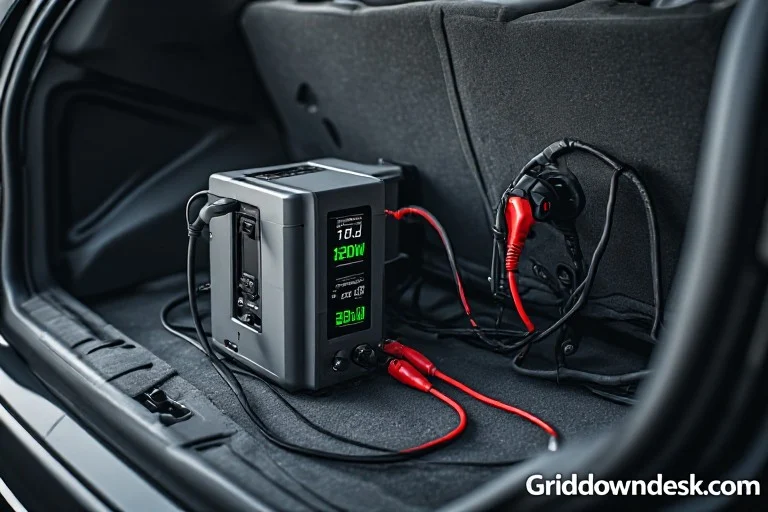
We tested the charging speed of a 1000Wh LiFePO4 power station (with a 500W max solar/DC input) using three different vehicle connection methods, with the car engine running at 2000 RPM.
| Charging Method | Measured Input Wattage | Time to Charge 0–80% (1000Wh unit) | Wiring Requirements |
|---|---|---|---|
| Standard Cigarette Lighter (10A) | 95W – 110W | ~9.5 hours | Plug-and-play (but very slow) |
| Heavy-Duty Cigarette Lighter (15A) | 140W – 160W | ~6.5 hours | Upgraded 15A socket & fuse |
| 40A DC-DC Charger (Hardwired) | 450W – 480W | ~1.8 hours | 4 AWG wire, inline fuse, ignition-switched |
Note: Charging speed naturally tapers off as the battery approaches 100% due to the BMS (Battery Management System) reducing current to balance the cells.
Calculating your on-the-road charge time
To estimate how much energy you can harvest during a drive, use this simple formula. For foundational battery math, see our guide on mAh to Wh battery capacity calculator.
Energy Harvested (Wh) = Average Charging Watts × Hours of Driving
Example Calculation:
- You have a 4-hour drive to your campsite.
- Using a 40A DC-DC charger pulling a steady 450W.
- Energy harvested: 450W × 4 hours = 1800 Wh.
This is more than enough to fully charge a 1000Wh station and still have power to spare, transforming your vehicle into a highly efficient mobile power plant.
Best practices for safe vehicle charging
- Always charge with the engine running: Drawing 400W+ from a stationary car will drain the starter battery in under 2 hours, leaving you stranded. The alternator must be spinning to supply the power.
- Use an ignition-switched connection: Hardwired DC-DC chargers must be connected to a fuse that is only live when the key is in the "ON" or "ACC" position. This prevents the charger from silently draining your car battery overnight.
- Mind the wire gauge: For a 40A DC-DC charger, standard speaker wire or thin automotive cable is a fire hazard. You must use at least 4 AWG (or 25 mm²) pure copper wire, kept as short as possible (under 3 meters) to minimize voltage drop.
- Check your alternator capacity: A typical modern car alternator outputs 100A to 150A. A 40A (480W) draw is generally safe, but if you have an older vehicle or a small alternator (under 80A), consult a mechanic before installing a high-draw DC-DC system.
Maintaining your mobile setup
Vehicles are harsh environments. Vibrations can loosen terminal connections, and heat in the trunk can degrade cables. Inspect your DC-DC wiring and fuses every 3 months. Ensure your power station is secured so it doesn't become a projectile during sudden braking. For comprehensive battery care instructions, see our guide on how to maintain and store your portable power station.
FAQ
Will charging a power station damage my car's alternator? Modern alternators are robust, but they do generate significant heat under continuous high load. Ensure your engine has adequate cooling (e.g., don't charge at high speeds while towing uphill in hot weather). The alternator will not "burn out" instantly, but excessive, unventilated load can shorten its lifespan.
Can I use a DC-DC charger to charge my power station while it's also powering a fridge? Yes, this is the ideal setup. The DC-DC charger will prioritize powering the fridge and use any remaining alternator capacity to charge the power station. This is known as "pass-through" or prioritized charging.
Why does my power station stop charging after the car turns off? This is a safety feature. The power station detects the voltage drop (from ~13.8V when running to ~12.2V when off) and automatically stops drawing current to prevent killing your car's starter battery.
Is a DC-DC charger better than solar charging? They serve different purposes. Solar is free and passive but weather-dependent. A DC-DC charger is highly reliable and fast, but consumes fuel and requires the engine to run. For serious overlanding, using both simultaneously is the gold standard.