Power Station for Space Heater: Runtime Guide
Short answer
Yes, a portable power station can run a standard 1500W space heater, but only for a very short time. A 1000Wh power station will power a 1500W heater for approximately 35 to 40 minutes before depleting. For meaningful winter blackout heating, you must switch to low-wattage alternatives like electric blankets (50W-100W) or heated mattress pads, which can run for 8 to 15 hours on the same battery.
The 1500W reality check
The vast majority of consumer ceramic, oil-filled, and infrared space heaters have a maximum setting of 1500 Watts. This is not a marketing number; it is the physical limit of a standard 15-Amp household electrical circuit (120V × 15A = 1800W, with a 20% safety margin).
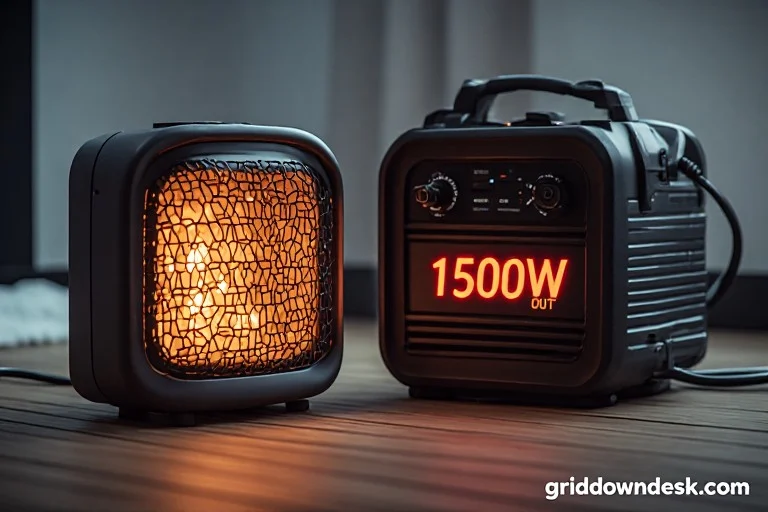
When you turn a space heater to "High," it draws a continuous 1500W from your power station. Unlike a refrigerator that cycles on and off, a space heater runs constantly to maintain temperature. This creates a massive, uninterrupted drain on your battery.
Calculating the exact runtime
To understand exactly how long your heater will run, we apply the standard runtime formula. For a detailed breakdown of this math, see our guide on UPS runtime explained: VA vs watt-hours.
Runtime (hours) = (Battery Capacity in Wh × Inverter Efficiency) ÷ Heater Wattage
Note: We use 0.85 for inverter efficiency to account for the energy lost and heat generated when converting DC battery power to high-wattage AC power.
Example Calculations:
- 500Wh Power Station: (500 × 0.85) ÷ 1500W = ~0.28 hours (17 minutes)
- 1000Wh Power Station: (1000 × 0.85) ÷ 1500W = ~0.56 hours (34 minutes)
- 2000Wh Power Station: (2000 × 0.85) ÷ 1500W = ~1.13 hours (1 hour 8 minutes)
As the math shows, using a space heater as a primary heat source during a multi-day blackout is not sustainable with current portable battery technology.
The smart alternative: Personal heating
Instead of trying to heat the air in a room (which is highly inefficient), the proven strategy for blackouts is to heat the person. By switching to personal heating devices, you reduce your power draw by 90% to 95%, extending your battery life from minutes to days.
Low-wattage heating alternatives:
- Electric Blanket: 50W to 100W. A 1000Wh station can run this for 8.5 to 17 hours.
- Heated Mattress Pad: 60W to 120W. Provides consistent warmth throughout the night with minimal draw.
- Heated Vest/Jacket: 15W to 30W. Can be powered directly via the power station's USB-C or 12V DC port, bypassing the AC inverter entirely for maximum efficiency.
- Hot Water Bottle: 0W. The ultimate zero-electricity solution for pre-warming a bed.
Critical safety requirements for high-wattage loads
If you must run a space heater for a short period (e.g., to take the chill off a room before bed), you must adhere to these strict safety rules:
- Pure Sine Wave is Mandatory: High-wattage resistive and fan-driven loads require clean power. A modified sine wave inverter will overheat and may trigger thermal shutdowns.
- Check Continuous and Surge Ratings: Ensure your power station's continuous AC output is rated for at least 1800W to 2000W to safely handle the 1500W heater plus a small buffer for the internal fan startup surge.
- Monitor Inverter Temperature: Pushing a power station to its maximum wattage limit generates significant internal heat. Ensure the unit's cooling fans are unobstructed and do not cover the device with blankets or place it in an enclosed space.
- Never leave unattended: Just like with wall power, a space heater powered by a battery should never be left running while you sleep or leave the room.
Maintaining your winter readiness
A power station is your lifeline during a winter storm, but lithium batteries lose capacity in the cold and self-discharge over time. To ensure your unit is ready when the temperature drops, store it indoors at room temperature and check the charge level monthly. For comprehensive battery care instructions, see our guide on how to maintain and store your portable power station.
FAQ
Can I run the space heater on the "Low" setting to save battery? Yes, but the savings are less than you might think. The "Low" setting on most heaters is 750W. While this doubles your runtime compared to "High," a 1000Wh station will still only last about 1 hour and 10 minutes.
Will a power station recharge from solar while running a heater? No. Even a large 400W solar array will only produce about 300W in ideal winter sun. This is far less than the 1500W the heater is consuming. The battery will continue to drain, just at a slightly slower rate.
Are oil-filled radiator heaters more efficient than ceramic ones? No. Both are 100% efficient at converting electricity to heat (1 Watt in = 1 Watt of heat out). Oil-filled heaters simply retain heat longer after being turned off, but while they are actively drawing power, they still consume up to 1500W.
Can I use a 12V DC car heater with my power station? Yes, and it is much more efficient. A 12V DC car heater typically draws 150W to 200W. By plugging it directly into the power station's 12V cigarette lighter port, you bypass the AC inverter, avoiding the 15% energy loss and significantly extending your runtime.