How Long Will Your UPS Keep Your Home Office Running?
Short answer
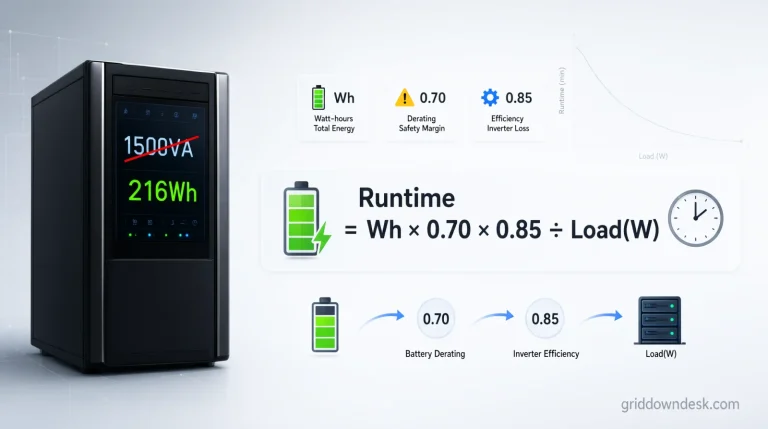
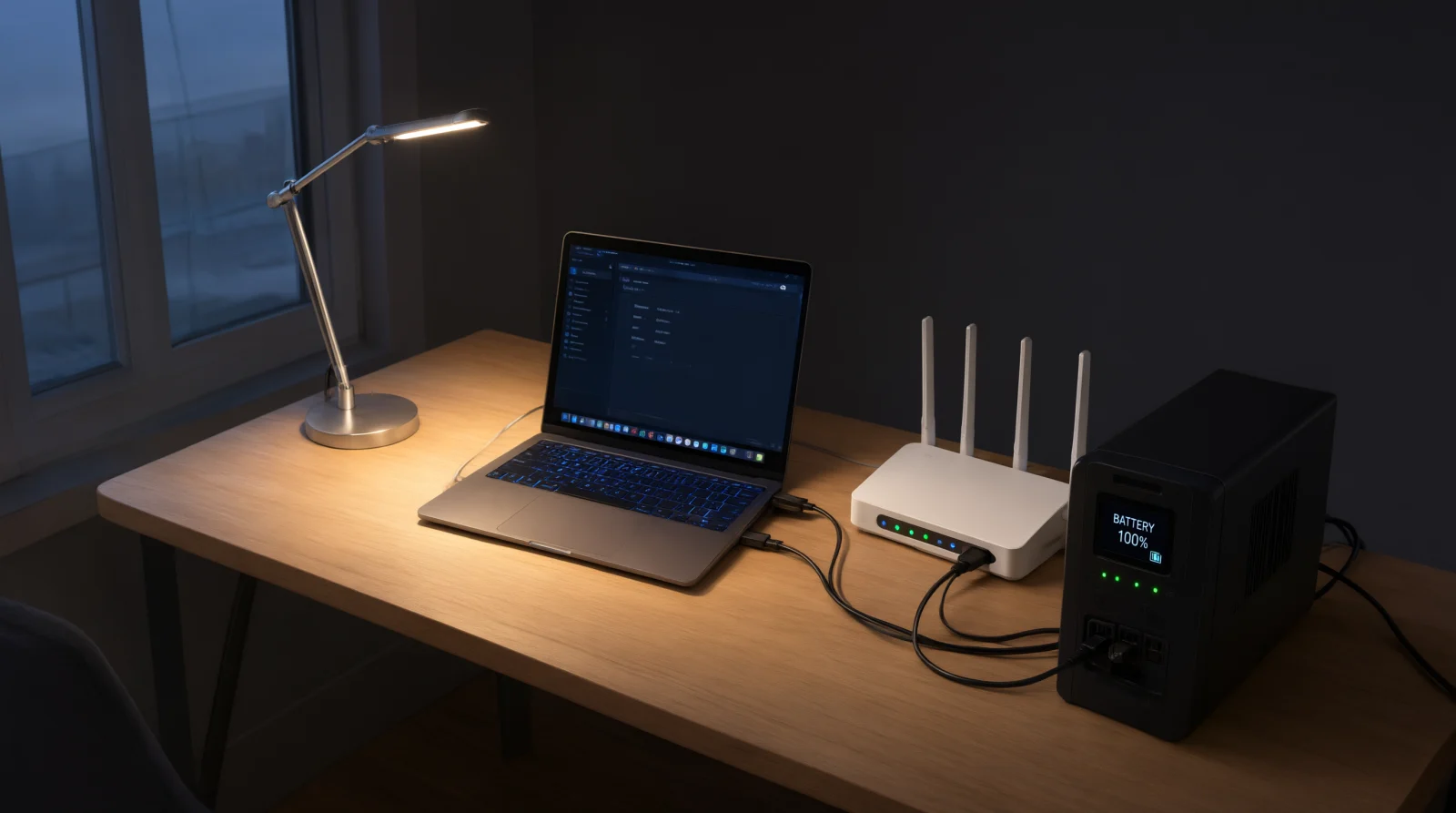
A UPS runs for as long as its battery energy lasts, measured in watt-hours (Wh), not in VA. Divide the usable battery energy by the power your devices draw in watts to get a realistic runtime estimate. For a typical home office drawing 100W, a standard UPS with 216Wh battery capacity will run for about 1 hour and 17 minutes.
Why the VA number on the box misleads you
The big number on the UPS box, for example 1500VA, describes how much load the UPS can supply at one moment. It says nothing about how long the battery can keep supplying it. That is why a unit with a large VA rating can still shut down after a few minutes when it carries a heavy load.
VA is also not the same as watts. The watts a UPS can deliver equal its VA rating multiplied by a power factor, and many consumer units give noticeably fewer watts than VA. Look for the W rating on the label. It is the number that matters when you add up your devices.
The formula that actually works
In words: runtime in hours = battery energy (Wh) × usable share × inverter efficiency ÷ load (W).
Here is what each term means:
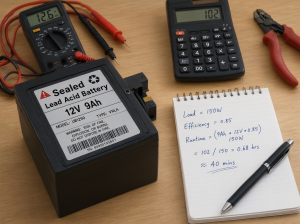
Battery energy is volts multiplied by amp-hours, printed on the battery label. A 12 V battery rated 9 Ah stores about 108 Wh. Add up every battery inside the UPS.
Usable share is the part of that energy you can actually take out. The UPS shuts down before the battery is empty to protect it, and an old battery holds less than a new one. For lead-acid batteries, assume 70 percent usable share.
Inverter efficiency reflects the losses when the UPS turns battery power into mains power. It is never 100 percent. For most consumer UPS units, assume 85 percent efficiency.
Load is the total power of everything plugged in, in watts.
A real calculation for your home office
Take a typical UPS with two 12V 9Ah batteries inside. The total battery energy is 216 Wh (12V × 9Ah × 2 batteries). Using the formula with 70 percent usable share and 85 percent inverter efficiency:
Usable energy is 216 × 0.70 × 0.85, which equals about 128 Wh.
Now divide by different loads to see how long your home office will run:
| Load | Runtime estimate |
|---|---|
| 600 W (gaming desktop + monitor) | about 13 min |
| 300 W (desktop + monitor + router) | about 26 min |
| 100 W (laptop + monitor + router) | about 1 h 17 min |
| 20 W (router only) | about 6 h 25 min |
These numbers come straight from the formula. They are estimates, not test results. The pattern is the useful part: the same battery gives a few minutes at a heavy load and many hours at a light one, which is why a big VA number alone tells you so little.
Why real runtime is usually shorter
The formula gives an upper estimate. In practice, your runtime will be shorter because:
- A battery loses capacity as it ages. A 3-year-old battery may hold only 60 percent of its original capacity.
- The battery gives up less energy when it is drained quickly. High loads reduce efficiency.
- The UPS itself uses some power just to stay switched on, which matters most at small loads.
- Heat and cold both reduce what a battery can deliver.
Treat the formula as an upper estimate and plan with some margin. If you need 30 minutes of runtime, size your UPS for 45 minutes.
How to find your actual load
The most accurate way is to plug a small watt meter between the wall and the UPS input, or between the UPS output and your devices, and note the reading during normal use. Write down both the typical and the highest value. Your devices must stay below the W rating of the UPS, with room to spare.
If you do not have a watt meter, add up the wattage on the power adapters. This gives a reasonable estimate, but real-world usage is often 20 to 30 percent lower than the adapter rating, because devices rarely draw maximum power continuously.
Practical tips for home office setup
Compare the W rating and the battery energy, not only the VA number. A 1500VA UPS with 600W rating and 216Wh battery will run your 100W home office for about 1.5 hours. A 1000VA UPS with 800W rating and 432Wh battery will run for 3 hours. The second unit is better for long outages, even though the VA number is smaller.
Measure the real load instead of adding up the numbers on the power adapters. Your laptop charger may be rated at 65W, but during normal work it draws 30-40W.
For a router and a modem, a small dedicated backup can waste less energy than a large mains UPS, because it avoids converting power twice. Check the specifications before you buy.
Never wire up improvised batteries. Wrong connections can overheat and start a fire. Use certified equipment and follow the manufacturer’s instructions.
More in Power Backup guides.
FAQ
Does a higher VA rating mean a longer runtime? Not by itself. VA tells you how much load the unit can carry. Runtime depends on battery energy, so two units with the same VA can run for very different times.
How do I find the battery energy? Multiply volts by amp-hours on each battery label and add the results together. Most consumer UPS units have one or two 12V 7-9Ah batteries inside.
Can I add batteries to run longer? Only if the manufacturer sells an external battery pack for your exact model. Do not improvise.
How often should I replace the UPS battery? Every 3 to 5 years, or when the runtime drops noticeably. Most UPS units have a battery test function that tells you if the battery is still healthy. Run this test every six months.
Will my laptop battery help during an outage? Yes, a laptop with a healthy battery adds 30-60 minutes of runtime on top of the UPS. This is why laptops are better for home office backup than desktop computers.