Extension Cord Sizing & Safety Guide for Backup Power
Short answer
To safely power high-wattage appliances (over 1000W) from a backup power source, you must use a heavy-duty extension cord rated for the load. For runs up to 50 feet, use a 12 AWG cord for loads up to 1500W, and a 10 AWG cord for loads up to 1875W. Never use thin 14 AWG or 16 AWG "lamp cords" for refrigerators, space heaters, or power tools, as they will overheat, cause dangerous voltage drop, and potentially melt or catch fire.
The "Any Cord Will Do" reality
A common and dangerous misconception is that an extension cord is just a passive wire, and any cord that physically fits the plug will work. In reality, every wire has electrical resistance.
When you push high amperage through a thin, long wire, that resistance converts electrical energy into heat. This causes two critical failures:
- Voltage Drop: The appliance at the end of the cord receives less than 120V. Inductive loads (like refrigerator compressors) will draw more current to compensate, creating a vicious cycle that overheats the cord and trips the power station's inverter.
- Fire Hazard: The insulation on undersized cords is not rated for the heat generated by high continuous loads. Prolonged use can melt the jacket, expose live wires, and ignite surrounding materials.
Real-world wire gauge (AWG) breakdown
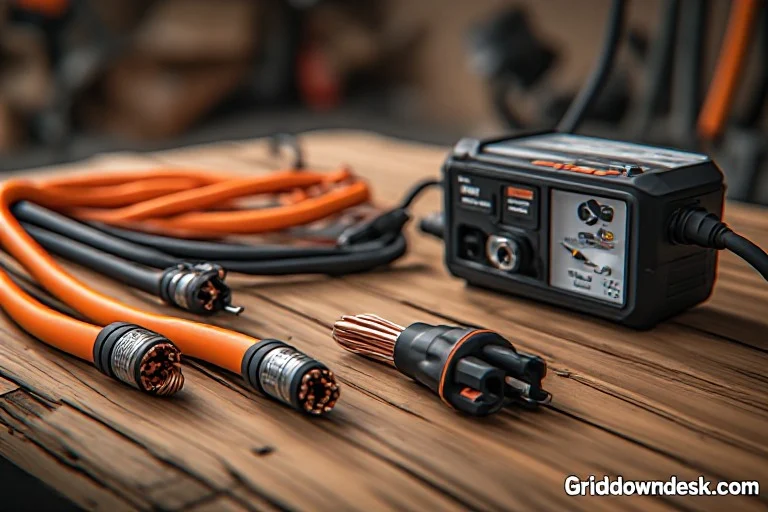
The American Wire Gauge (AWG) system is counterintuitive: the lower the number, the thicker the wire and the higher the safe current capacity.
| Wire Gauge (AWG) | Max Safe Continuous Load | Recommended Use Case | Max Length for 1500W Load |
|---|---|---|---|
| 16 AWG | ~100W (0.8A) | Phone chargers, small lamps, electronics | N/A (Never use for high load) |
| 14 AWG | ~1500W (12.5A) | Light-duty tools, small fans (short runs only) | Under 25 feet |
| 12 AWG | ~1875W (15A) | Refrigerators, space heaters, sump pumps | Up to 50 feet |
| 10 AWG | ~2500W (20A) | Heavy-duty tools, well pumps, large heaters | Up to 100 feet |
Note: Always look for cords labeled "SJTW" or "STW", which indicates a heavy-duty, water-resistant jacket suitable for outdoor or garage use.
Step-by-step cord sizing formula
To ensure your setup is safe and efficient, follow this simple sizing logic. For broader load calculations, see our guide on home backup power calculator sizing.
Step 1: Identify the Appliance Wattage Check the nameplate on the device. Let's assume a space heater drawing 1500W.
Step 2: Calculate the Amperage Amperage (A) = Watts (W) ÷ Voltage (V) 1500W ÷ 120V = 12.5 Amps.
Step 3: Match to Wire Gauge and Length Consult the table above. For 12.5 Amps, a 14 AWG cord is technically at its absolute limit, but only for very short distances. To maintain a safe margin and prevent voltage drop, a 12 AWG cord is the mandatory minimum. If the run must exceed 50 feet, upgrade to 10 AWG.
Best practices for backup power cabling
- Never Daisy-Chain Cords: Plugging one extension cord into another multiplies the resistance and connection points, drastically increasing voltage drop and fire risk. Always use a single, appropriately long, heavy-duty cord.
- Fully Unroll the Cord: Never use an extension cord while it is still coiled on its reel. A coiled cord acts as an inductor, trapping heat inside the bundle. This can melt the insulation and cause a fire in minutes under heavy load. Always unroll it completely.
- Keep Connections Dry: If routing power outdoors or into a garage, use a cord with a molded, weather-resistant plug and keep the connection point elevated off wet ground.
- Inspect Before Every Use: Check for cracked insulation, bent prongs, or discoloration on the plug ends (a sign of past overheating). If damaged, discard the cord immediately.
Maintaining your cabling equipment
Proper storage extends the life of your extension cords. Do not wrap them tightly around your elbow or the cord itself, as this stresses the internal copper strands and leads to breakage. Instead, use the "over-under" coiling method or a dedicated cord reel. Store them in a cool, dry place. For comprehensive safety and equipment care principles, see our guide on how to maintain and store your portable power station.
FAQ
Can I use a 14 AWG cord for my refrigerator during a short outage? It is not recommended. While a fridge only draws ~150W continuously, its compressor has a startup surge of 800W–1200W. A long 14 AWG cord will cause a voltage drop during this surge, potentially stalling the compressor and tripping your power station. Use 12 AWG for peace of mind.
Why does my power station shut off when I use a long extension cord, even if the load is low? Severe voltage drop at the appliance end can cause the appliance's internal power supply to draw erratic, spiky current to compensate. The power station's inverter may interpret this as a fault or short circuit and trigger its protection mode.
Are "flat" extension cords safe for high loads? Only if they are explicitly rated for the amperage you are drawing. Some modern flat cords are 14 AWG and safe for up to 1500W, but many cheap flat cords are 16 AWG and are strictly for low-power electronics. Always check the embossed text on the jacket.
Does a thicker cord improve the efficiency of my power station? Yes. By minimizing resistance, a thicker (lower AWG) cord reduces energy lost as heat, ensuring more of the battery's stored watt-hours actually reach your appliance, slightly extending your overall runtime.