Home Security System Blackout Power Guide
Short answer
To keep your home security system operational during a blackout, you need a pure sine wave UPS or portable power station with 300W to 500W of continuous output. A typical setup (NVR, PoE switch, and 4-8 cameras) draws 50W to 100W continuously. A 500Wh backup unit will provide 4 to 8 hours of uninterrupted surveillance, preventing the blind spots and vulnerability that occur when security systems rely solely on grid power.
The vulnerability reality
A power outage is a prime time for security breaches. When the grid fails, standard CCTV systems and wired alarm panels go dark instantly.
While some modern IP cameras have tiny internal batteries, they typically last only 15 to 30 minutes. Furthermore, if the Network Video Recorder (NVR) or the central alarm panel loses power, the entire system becomes blind and deaf, regardless of whether individual cameras have temporary power. Securing the central hub (NVR/Panel) and the network infrastructure (PoE switch/router) is the absolute priority.
Real-world security system power consumption
Power draw scales with the number of cameras and the activation of infrared (IR) night vision, which significantly increases power demand.
Typical power consumption:
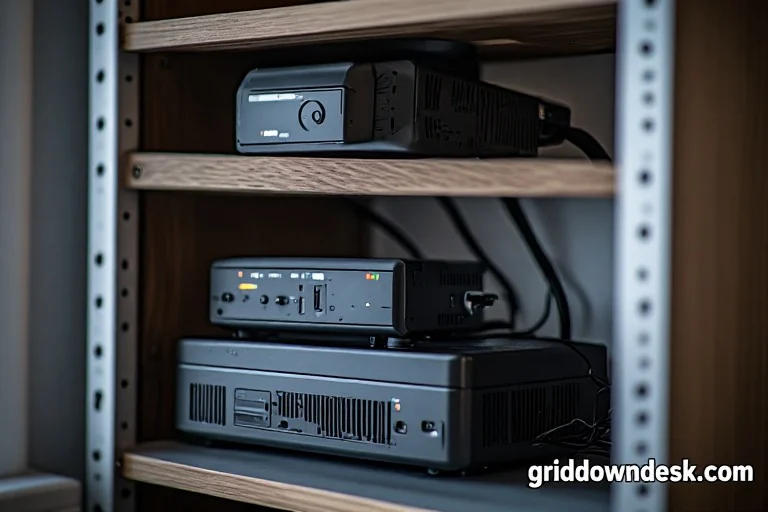
- Network Video Recorder (NVR) / DVR: 15W – 30W continuous.
- PoE Switch (4 to 8 ports): 20W – 40W (idle) up to 60W – 80W (with multiple cameras in IR night mode).
- Alarm Control Panel: 5W – 10W continuous.
- Wi-Fi Router (for remote viewing): 8W – 12W continuous.
- Total Combined Load: 50W to 100W for a standard 4-8 camera residential setup.
Note: PTZ (Pan-Tilt-Zoom) cameras draw significantly more power (15W-25W each) when actively moving or using built-in heaters in cold weather.
Calculating your security runtime
To ensure your property remains protected throughout a typical outage, we calculate the runtime based on the total continuous load. For the foundational math, see our guide on home backup power calculator sizing.
Runtime (hours) = (Battery Capacity in Wh × Efficiency) ÷ Total Load (W)
Note: Use 0.85 efficiency for AC inverter setups. If you power the PoE switch and NVR via direct 12V/24V DC adapters, use 0.95 efficiency.
Example Calculation (Standard 4-Camera Setup):
- Total load (NVR + PoE Switch + Router): 70W.
- Power source: 500Wh pure sine wave UPS.
- Usable energy (AC): 500 Wh × 0.85 = 425 Wh.
- Runtime: 425 Wh ÷ 70W = ~6 hours.
If you optimize the setup using direct DC power (0.95 efficiency), the runtime extends to: (500 × 0.95) ÷ 70W = ~6.8 hours.
Best practices for security backup
- Centralize the Backup: Do not try to battery-backup every single camera individually. Instead, plug the NVR, the PoE switch, and the internet router into a single, adequately sized UPS. This is far more efficient and easier to maintain.
- Pure Sine Wave is Recommended: While some basic switching power supplies in NVRs can tolerate modified sine wave, sensitive PoE negotiation and hard drives inside the NVR perform best and last longer with clean, pure sine wave power.
- Manage IR Night Vision: If facing an extended multi-day outage, consider configuring your NVR to disable IR night vision on non-critical cameras to reduce the PoE switch load by 20W-30W, extending your battery life.
- Secure the Physical Location: Ensure the UPS and networking gear are placed in a locked, ventilated cabinet. A backup system is useless if it can be easily unplugged or stolen during a blackout.
Maintaining your security readiness
Security systems are "set and forget" installations, which makes them prone to backup neglect. A UPS battery left untested for a year will likely fail when needed most. Test the system quarterly by unplugging the main wall power and verifying that the cameras and NVR remain online via your smartphone app. For comprehensive battery care instructions, see our guide on how to maintain and store your portable power station (the same maintenance principles apply to UPS batteries).
FAQ
Can I use a portable power station instead of a traditional rack-mount UPS? Yes, a compact LiFePO4 power station is an excellent choice. It offers longer lifespan and higher capacity than traditional lead-acid UPS units. Just ensure it has a pure sine wave inverter and enough continuous wattage to handle the PoE switch's startup surge.
Will my security system automatically resume recording when grid power returns? Yes. Modern NVRs and PoE switches are designed to boot up automatically when power is restored. The UPS will seamlessly transition back to line power, and the system will resume normal operation without manual intervention.
What about wireless (Wi-Fi) security cameras? Wi-Fi cameras are highly dependent on the router staying online. Even if the camera has a small internal battery, it is useless if the Wi-Fi router is dead. Always prioritize backing up the router and the central hub over individual wireless cameras.
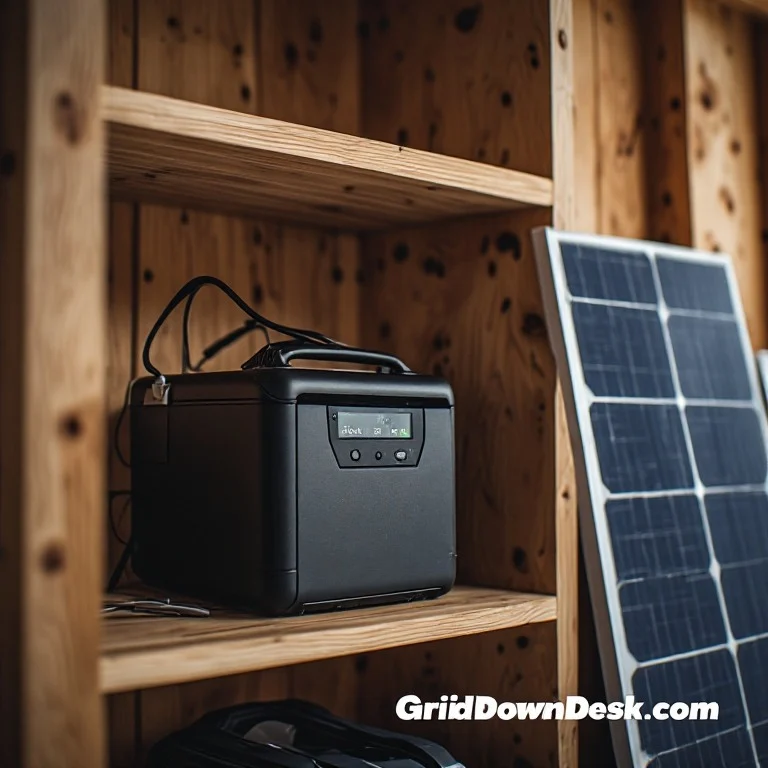
Can I power my security system with solar panels during a long outage? Absolutely. A 100W to 200W solar panel connected to a portable power station can easily offset the 50W-100W continuous draw of a security system during daylight hours, creating a self-sustaining loop for extended blackouts. For sizing your solar array, refer to our solar panel sizing calculator guide.