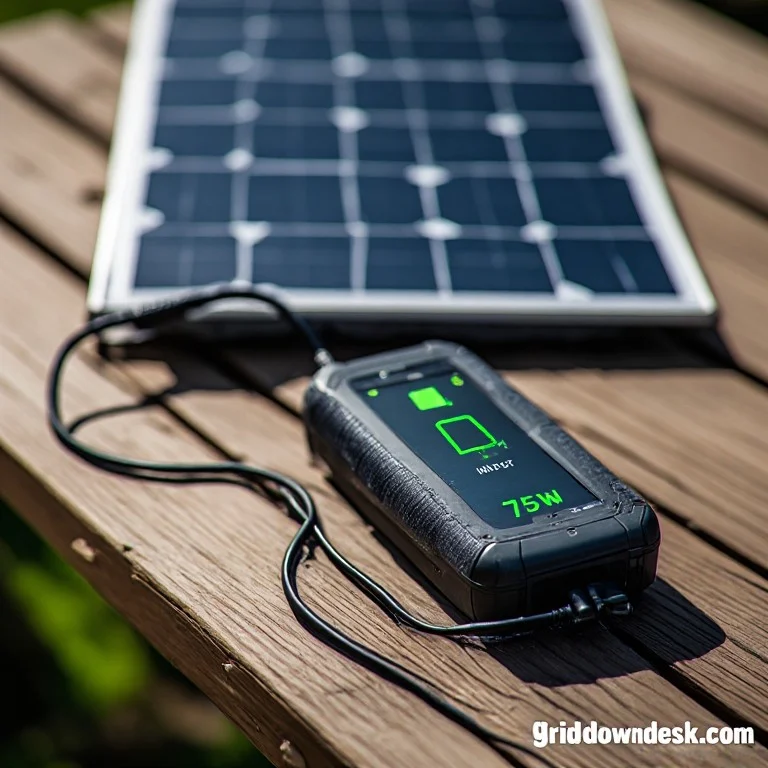
Solar Panel Sizing Calculator for Power Stations
Short answer
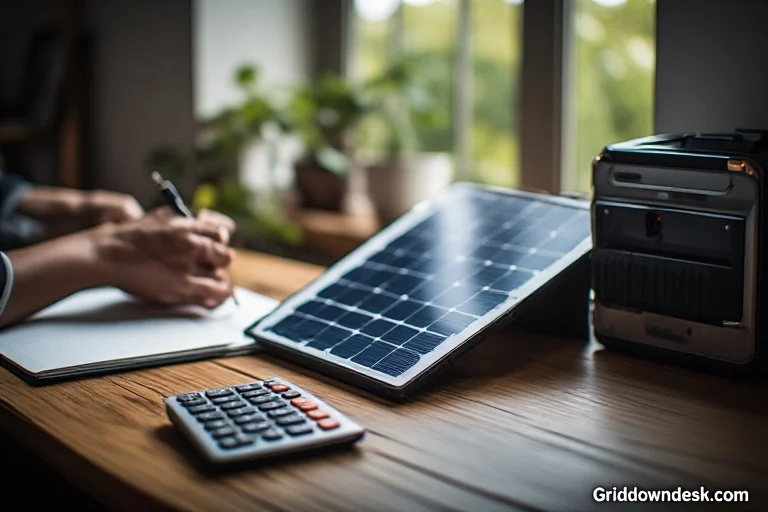
To calculate the solar panel size needed to charge your power station, use this formula: Required Panel Watts = (Power Station Capacity in Wh) ÷ (Peak Sun Hours × 0.75). The 0.75 factor accounts for real-world derating (MPPT efficiency, cable loss, and suboptimal sun angles). For example, to charge a 1000Wh station in 5 peak sun hours, you need at least 266W of solar panels (e.g., three 100W panels).
The "Rated Wattage" illusion
A common mistake is assuming a 100W solar panel will deliver 100W to your power station. As detailed in our guide on real solar panel output: winter vs summer, laboratory-rated wattage (STC) is almost never achieved in the field.
To get an accurate calculation, we must apply a derating factor of 0.70 to 0.75. This accounts for:
- MPPT charge controller efficiency (~95%).
- Cable resistance and connector losses (~3-5%).
- Suboptimal sun angles and minor atmospheric interference (~15-20%).
The 4-step solar sizing formula
Follow this exact process to size your solar array for a specific charging goal.
Step 1: Determine your target charge. Do you need to charge from 0% to 100%, or just replenish your daily usage? For a full charge, use the total Wh capacity of your station.
Step 2: Find your "Peak Sun Hours" (PSH). This is not the number of daylight hours. It is the number of hours per day when solar irradiance averages 1000 W/m².
- Summer (clear sky): 5 to 6 hours.
- Winter (clear sky): 2 to 3 hours.
- Overcast/Cloudy: 1 to 1.5 hours.
Step 3: Apply the derating factor. Multiply your panel's rated wattage by 0.75 to get the realistic average output.
Step 4: Calculate required wattage. Formula: Required Panel Watts = Target Wh ÷ (Peak Sun Hours × 0.75)
Real-world sizing examples
Scenario A: Weekend Camping Replenishment
- Goal: Replenish 400Wh of daily usage.
- Conditions: Summer, 5 Peak Sun Hours.
- Calculation: 400Wh ÷ (5 hours × 0.75) = 106W.
- Result: One high-quality 100W foldable panel is sufficient.
Scenario B: Full Off-Grid Recharge in Winter
- Goal: Charge a 2000Wh power station from 0% to 100%.
- Conditions: Winter, 2.5 Peak Sun Hours.
- Calculation: 2000Wh ÷ (2.5 hours × 0.75) = 1066W.
- Result: You need approximately 1000W to 1100W of solar panels (e.g., five 200W panels) to achieve a full charge in a single winter day.
Best practices for solar array configuration
- Respect the MPPT Input Limit: Every power station has a maximum solar input voltage (Voc) and wattage. Exceeding the voltage limit will permanently fry the charge controller. Always check the manual before connecting panels in series.
- Series vs. Parallel:
- Series (connecting positive to negative) increases voltage, which is better for MPPT efficiency in low light or with long cable runs.
- Parallel (connecting positive to positive) increases amperage, which is safer if you are close to the station's voltage limit.
- Oversize slightly: Solar panels degrade by about 0.5% per year, and dust accumulation is inevitable. Oversizing your array by 10-20% ensures you still meet your charging goals as the system ages.
- Match panel chemistries: If connecting multiple panels, ensure they have the same voltage and wattage ratings. Mixing different panels in series will cause the entire array to underperform to the level of the weakest panel.
Maintaining your solar investment
Foldable solar panels are durable, but their junction boxes and cables are vulnerable to wear. Always coil the cables loosely (never wrap them tightly around the panel, which can degrade internal wires) and store the panel in a dry place. For comprehensive care instructions for the devices you are charging, see our guide on how to maintain and store your portable power station.
FAQ
Can I charge my power station through a glass window? Yes, but you must adjust your calculations. Standard window glass blocks a portion of the solar spectrum and causes reflections. Apply a derating factor of 0.40 to 0.50 instead of 0.75. A 100W panel will only deliver 40W-50W indoors.
What happens if I connect more solar wattage than the station's maximum rating? Modern MPPT controllers are smart. If you connect 400W of panels to a station rated for 300W max input, the controller will simply "clip" the excess and only draw 300W. It will not damage the unit, provided the voltage (Voc) does not exceed the maximum limit.
Do I need a separate charge controller? No. All modern portable power stations have built-in MPPT charge controllers. You only need a separate controller if you are building a custom DIY battery bank.
Why is my charging speed fluctuating? Clouds, passing shadows, and the sun's changing angle cause real-time fluctuations. The MPPT controller is constantly recalculating the optimal voltage and current to extract the maximum possible power at that exact second. This is normal behavior.