Cost per kWh Calculator: Grid vs Generator vs Power Station
Short answer
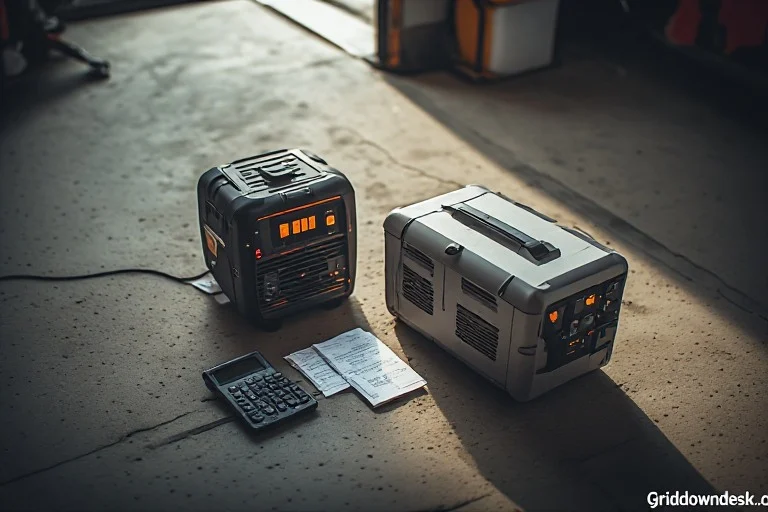
The real cost of 1 kWh of energy varies drastically by source. Grid power typically costs $0.10–$0.15 per kWh. A gasoline inverter generator costs $0.50–$0.80 per kWh when factoring in fuel and maintenance. A LiFePO4 portable power station, when charged from the grid, costs approximately $0.20–$0.30 per kWh over its lifespan, making it the most cost-effective backup solution for frequent, short-to-medium duration outages.
The "Cheap Generator" illusion
Many consumers assume that because a $500 generator has a lower upfront cost than a $1,000 power station, it is the cheaper option. This is a classic financial illusion.
A generator is an internal combustion engine. Every hour it runs, it consumes degrading assets: gasoline, oil, spark plugs, and mechanical lifespan. When you calculate the Levelized Cost of Energy (LCOE)—the total lifetime cost divided by total energy produced—the generator's per-kWh cost skyrockets, especially at the partial loads typical of home backup scenarios.

Real-world cost per kWh breakdown
To calculate accurately, we must account for both variable costs (fuel, grid electricity) and fixed costs (equipment depreciation, maintenance).
1. Grid Power (Baseline)
- Formula:
Cost per kWh = Your Utility Rate - Example: $0.15 per kWh. (Simple, no depreciation).
2. Gasoline Inverter Generator
- Formula:
Cost per kWh = (Fuel Cost per Hour + Maintenance per Hour) ÷ Output kW - Example: A 2000W generator running at 1000W (1 kW) load.
- Fuel: 0.15 gallons/hour × $3.50/gallon = $0.525/hour.
- Maintenance (oil, plugs, depreciation): ~$0.10/hour.
- Total Cost per Hour: $0.625.
- Cost per kWh: $0.625 ÷ 1 kW = $0.625 per kWh.
3. LiFePO4 Portable Power Station
- Formula:
Cost per kWh = (Station Price ÷ Total Lifetime kWh) + Grid Charging Cost - Example: A $1,000, 1000Wh (1 kWh) station rated for 3,000 cycles to 80% capacity.
- Lifetime usable energy: 1 kWh × 3,000 cycles × 0.80 = 2,400 kWh.
- Depreciation cost: $1,000 ÷ 2,400 kWh = $0.41 per kWh.
- Grid charging cost (at 85% efficiency): $0.15 ÷ 0.85 = $0.17 per kWh.
- Total Cost per kWh: $0.41 + $0.17 = $0.58 per kWh.
Note: If you charge the power station via free solar panels, the charging cost drops to $0.00, bringing the total lifetime cost per kWh down to just $0.41, beating the generator significantly.
Step-by-step backup cost calculation
Use this method to evaluate your specific situation. For broader financial modeling, see our guide on generator vs power station TCO calculator.
Step 1: Estimate your annual backup energy need. (e.g., 5 outages/year × 10 hours × 500W average load = 25 kWh/year).
Step 2: Calculate 5-year generator cost. 25 kWh/year × 5 years × $0.625/kWh = $78.12 (plus the $500 upfront cost = $578.12).
Step 3: Calculate 5-year power station cost. The $1,000 station covers this easily within its 3,000-cycle lifespan. Total cost = $1,000 upfront + (125 kWh × $0.17 charging cost) = $1,021.25.
The Verdict: For very low usage (under 50 kWh/year), the generator wins on pure upfront math. However, if you experience frequent outages, work from home, or camp regularly (exceeding 100 kWh/year), the power station's lower per-kWh operational cost and zero maintenance quickly close the gap, while providing silent, indoor-safe power.
Best practices for minimizing backup energy costs
- Right-size your equipment: Running a 5000W generator to power a single 50W router is the most expensive way to generate electricity. Match the tool to the load.
- Prioritize DC charging: As detailed in our 12V DC vs 120V AC efficiency test, bypassing the inverter saves 10-15% of your energy, directly reducing your effective cost per kWh.
- Use solar for offset: Even a single 100W solar panel can offset a significant portion of your grid-charging costs during multi-day outages, driving your marginal cost per kWh toward zero.
Maintaining your financial investment
To ensure your calculated cost per kWh remains accurate, you must protect the lifespan of your equipment. Store your power station at a 60% charge in a cool, dry place, and perform regular maintenance on your generator. For comprehensive battery care instructions, see our guide on how to maintain and store your portable power station.
FAQ
Does the cost per kWh change if I run the generator at 25% load? Yes, drastically. Generators are highly inefficient at low loads. Fuel consumption does not scale linearly. A generator might use 0.1 gal/hr at 25% load and 0.15 gal/hr at 50% load, meaning your cost per kWh doubles at lighter loads.
What about propane generators? Propane is generally cheaper per BTU than gasoline and eliminates oil change frequency, reducing the maintenance cost per kWh by about $0.05. However, the lower energy density of propane means you burn more volume, keeping the overall cost per kWh roughly comparable to gasoline.
Is the depreciation calculation for power stations realistic? Yes. LiFePO4 chemistry is rated for 3,000+ cycles to 80% capacity. Even if you only use 50% of the battery per cycle, the lifespan extends further. The math is conservative and based on manufacturer cycle-life testing.
Can I claim tax deductions for backup power costs? In some jurisdictions, if the equipment is used to power certified medical devices or is part of a qualifying solar energy system, you may be eligible for tax credits, effectively lowering your upfront cost and your calculated cost per kWh. Consult a local tax professional.