Battery Bank Sizing Calculator: 12V vs 24V vs 48V Guide
Short answer
To size a backup battery bank, first calculate your total required Watt-hours (Wh), then divide by your chosen system voltage (12V, 24V, or 48V) to get Amp-hours (Ah). As a strict engineering rule: use 12V only for loads under 1000W; use 24V for 1000W–2000W; and use 48V for anything over 2000W. Higher voltages drastically reduce amperage, preventing dangerous heat buildup and allowing the use of thinner, safer, and cheaper wiring.
The "High Amp" reality
A common mistake in DIY backup power is building a massive 12V battery bank to run high-wattage appliances (like a well pump or microwave).
According to Ohm's Law (Amps = Watts ÷ Volts), a 2400W load on a 12V system draws 200 Amps. This requires dangerously thick, expensive 4/0 AWG cables, and any loose connection will generate enough heat to start a fire. The exact same 2400W load on a 48V system draws only 50 Amps, which can be safely handled by standard 4 AWG wiring. Increasing system voltage is the only safe way to scale up backup power.
The 3-step battery bank sizing formula
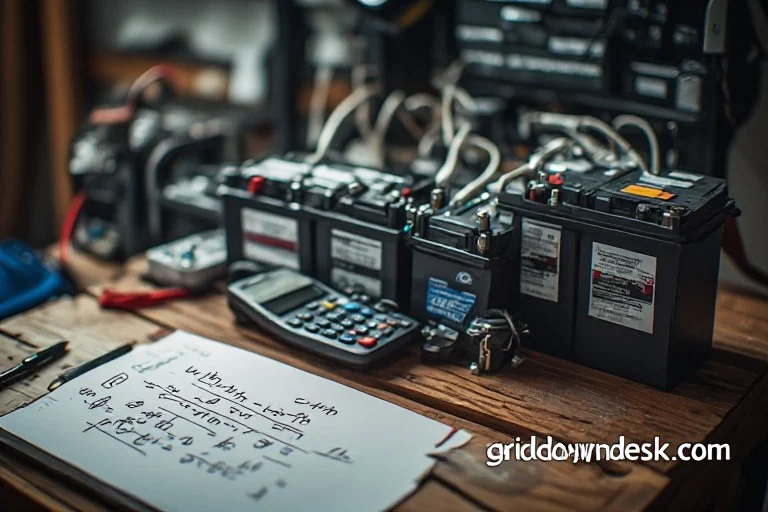
Follow this exact process to determine the physical size and configuration of your battery bank. For foundational load calculation, see our guide on home backup power calculator sizing.
Step 1: Calculate Total Required Watt-hours (Wh) Total Wh = (Daily Wh Usage × Days of Autonomy) ÷ Max Depth of Discharge (DoD) Note: For LiFePO4, use 0.80 (80% DoD). For Lead-Acid/AGM, use 0.50 (50% DoD) to prevent permanent damage.
Step 2: Choose System Voltage
- 12V: Best for small setups (under 1000W continuous).
- 24V: Ideal for medium homes or RVs (1000W – 2000W continuous).
- 48V: Mandatory for large homes or heavy loads (2000W+ continuous).
Step 3: Convert Wh to Amp-hours (Ah) Required Ah = Total Wh ÷ System Voltage
Real-world sizing example
Scenario: A cabin needs to run a refrigerator, lights, and a well pump, consuming 2000Wh per day. The owner wants 2 days of autonomy without sun, using modern LiFePO4 batteries.
- Total Wh: (2000Wh × 2 days) ÷ 0.80 DoD = 5000 Wh.
- System Voltage: The peak load (well pump surge) is 1500W. A 24V system is the safest, most efficient choice.
- Required Ah: 5000 Wh ÷ 24V = 208 Ah.
Result: You need a 24V, ~200Ah LiFePO4 battery bank. This can be achieved by wiring two 12V 200Ah batteries in series, or buying a single pre-built 24V 200Ah rack-mount unit.
If you attempted this on a 12V system, you would need 416Ah, requiring massive, unmanageable cables and suffering from severe voltage drop.
Best practices for bank configuration
- Limit parallel strings: When wiring batteries in parallel to increase Ah, try not to exceed 4 parallel strings. More than 4 strings leads to uneven charging, where the outer batteries degrade faster than the inner ones. It is always better to buy higher-capacity individual batteries and wire them in series to increase voltage.
- Use identical batteries: Never mix old and new batteries, or batteries of different brands/capacities, in the same bank. The weakest battery will dictate the performance and lifespan of the entire system.
- Fuse every connection: Every positive cable leaving a battery must have an appropriately sized ANL or Class T fuse within 18 inches of the terminal. This is non-negotiable for fire safety.
- Balance the wiring: Use a "diagonal" wiring method (positive on the first battery, negative on the last battery) to ensure equal cable resistance and balanced charging across all batteries in the bank.
Maintaining your battery bank
A large battery bank represents a significant financial investment. Keep the terminals clean and tight, as corrosion increases resistance and causes localized heating. Store the bank in a temperature-controlled environment. For comprehensive battery care instructions, see our guide on how to maintain and store your portable power station (the same principles apply to custom LiFePO4 and AGM banks).
FAQ
Can I use a 12V to 24V or 48V step-up converter instead of rewiring? No. Step-up converters for high continuous loads (1000W+) are inefficient, generate massive heat, and introduce a single point of failure. It is always safer and more efficient to wire the batteries natively to the desired system voltage.
Does a 48V system shock hazard require special handling? While 48V is technically considered "Extra Low Voltage" and is generally safe to touch, the amperage available from a large battery bank can melt metal and cause severe arc-flash burns if short-circuenced. Always use insulated tools and remove rings/watches when working on any battery bank.
Why do most portable power stations use 12V, 24V, or 48V internally? Reputable manufacturers design their internal battery packs to match the inverter's optimal voltage. A 2000W power station almost always uses a 48V (or sometimes 51.2V) internal architecture precisely to keep internal wiring thin, efficient, and safe.
How do I calculate the wire size for my battery bank? Use a voltage drop calculator. For a 24V system under 200A with a cable run under 3 feet, 2/0 AWG copper wire is typically the minimum safe standard. Never guess wire sizes; undersized wiring is the leading cause of electrical fires in DIY power systems.