Generator vs Power Station TCO Calculator Guide
Short answer
While a gas inverter generator has a lower upfront cost, a LiFePO4 portable power station often has a lower Total Cost of Ownership (TCO) over 5 years if used frequently (e.g., monthly outages or regular weekend camping). When factoring in fuel, oil changes, spark plugs, and noise mitigation, a $600 generator can cost over $1,200 in 5 years, whereas a $1,000 power station costs near $0 in operational expenses.
The "Sticker Price" illusion
When shopping for backup power, most consumers compare the initial purchase price: a $500 inverter generator versus a $1,000 portable power station. The generator seems like the obvious financial winner.
However, this is a classic "sticker price" illusion. A generator is a complex internal combustion engine that requires continuous inputs (fuel, oil, maintenance) to function. A LiFePO4 power station is a solid-state electronic device with no moving parts. To make an honest financial decision, you must calculate the Total Cost of Ownership (TCO) over a realistic 5-year lifespan.
Real-world 5-year cost variables
To build an accurate TCO model, we must account for the hidden costs of gas-powered equipment.
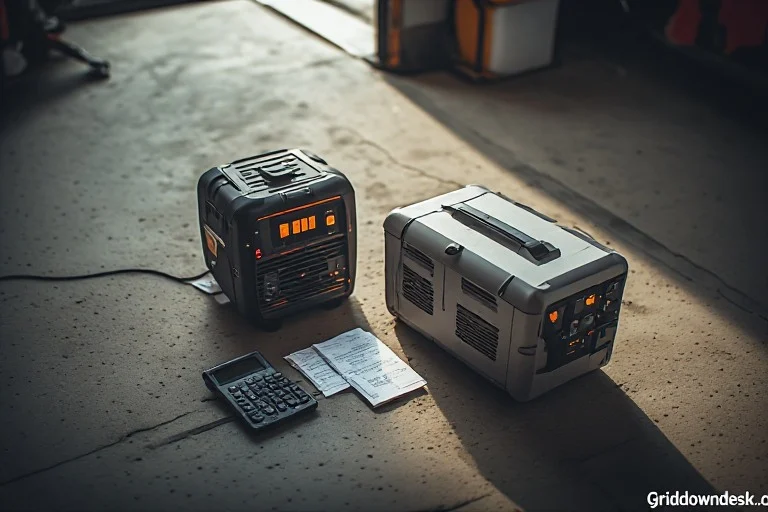
Typical 5-Year Operational Costs (Based on 20 uses/year, 5 hours each = 100 hours/year):
- Fuel (Gasoline): ~$150/year ($750 over 5 years, assuming $3.50/gallon and 0.5 gal/hr).
- Oil Changes: $20/year ($100 over 5 years, required every 50-100 hours).
- Spark Plug & Air Filter: $15/year ($75 over 5 years).
- Fuel Stabilizer & Degradation: $20/year ($100 over 5 years, to prevent carburetor varnish).
- Noise/Enclosure (Optional but recommended): $100 one-time cost for a sound-dampening box.
- Total Generator Add-ons: ~$1,125 over 5 years.
Note: LiFePO4 power stations have near-zero operational costs. Electricity for recharging costs pennies per cycle, and they require no oil, filters, or stabilizers. For details on chemistry lifespan, see our guide on LiFePO4 vs NMC battery chemistry.
The TCO Calculation Formula
Use this formula to compare your specific options over a 5-year period. For foundational sizing math, see our home backup power calculator sizing guide.
5-Year TCO = Upfront Purchase Price + (Annual Operational Cost × 5) + Replacement Costs
Example Calculation (5-Year Horizon):
- Option A: 2000W Inverter Generator
- Upfront: $600
- Operational (Fuel + Maintenance): $150 × 5 = $750
- Replacement (Carburetor rebuild or engine wear): $150
- Total 5-Year TCO: $1,500
- Option B: 1000Wh LiFePO4 Power Station
- Upfront: $900
- Operational (Grid charging @ $0.15/kWh): $10 × 5 = $50
- Replacement: $0 (Rated for 3,000+ cycles, easily lasting 10+ years)
- Total 5-Year TCO: $950
In this realistic scenario, the power station saves you $550 over 5 years, while also providing silent, indoor-safe, zero-emission power.
When the Generator Actually Wins
The math shifts if your use case involves massive, continuous loads. If you need to run a central AC unit, a well pump, and a refrigerator simultaneously for 12+ hours a day during multi-day outages, a generator's ability to be refueled indefinitely makes it the only viable option. A power station large enough to handle that load (e.g., 10kWh+) has a prohibitive upfront cost ($5,000+).
For a detailed breakdown of fuel math, refer to our inverter generator fuel consumption calculator.
Best practices for making the right choice
- Audit your actual usage: If you only lose power 1-2 times a year for a few hours, a small generator or a budget NMC power station might be more economical upfront. If you experience frequent, short outages or camp monthly, LiFePO4 is the undisputed financial winner.
- Factor in solar: If you add a 200W solar panel to your power station setup, your operational charging cost drops to exactly $0, further accelerating the ROI (Return on Investment).
- Consider resale value: Well-maintained LiFePO4 power stations retain about 60-70% of their value after 3 years due to high demand. Used generators with 100+ hours of runtime depreciate much faster and are harder to sell.
Maintaining your investment
Regardless of which path you choose, proper maintenance protects your financial investment. Run your generator monthly to keep the carburetor clean, or keep your power station at a 60% state of charge in a cool, dry place. For comprehensive battery care instructions, see our guide on how to maintain and store your portable power station.
FAQ
Does the TCO calculation apply to propane generators? Partially. Propane eliminates fuel stabilization costs and carburetor varnish issues, saving about $50-$75 over 5 years. However, propane has lower energy density, meaning you burn more volume to get the same wattage, which partially offsets the maintenance savings.
What if my power station's battery degrades? LiFePO4 batteries are rated to retain 80% of their capacity after 3,000+ full cycles. Even if you use it 3 times a week, it will take over 19 years to reach that point. For normal backup use, the battery will outlast the electronic inverter components.
Are there hidden costs to power stations? The only potential hidden cost is if you need to replace a proprietary charging cable or if you exceed the inverter's wattage limit and blow a fuse (which is usually user-replaceable for under $20). There are no recurring mechanical costs.
Can I claim a tax deduction for buying a power station? In some jurisdictions, if the power station is paired with solar panels and used for medical equipment or as part of a certified home energy resilience system, it may qualify for local tax credits. Check with a local tax professional.