100W Solar Panel Charging Time Guide
Short answer
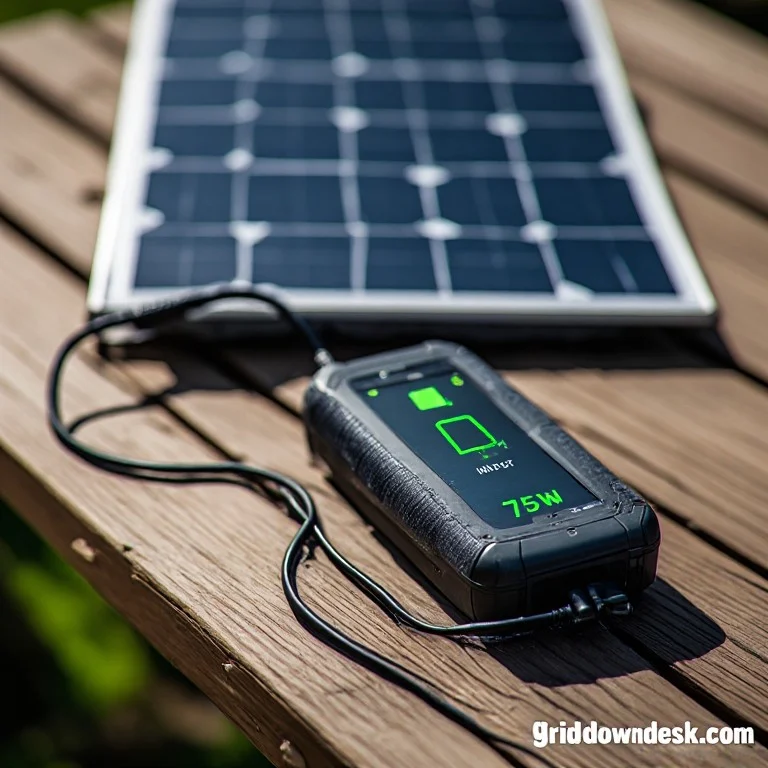
A 100W solar panel will charge a 500Wh portable power station in approximately 6 to 8 hours of good sunlight. This calculation assumes a realistic system efficiency of 75%, meaning the panel delivers about 75W of actual power to the battery, not the full 100W rated in laboratory conditions.
The charging time formula
To calculate exactly how long your power station will take to charge, use this straightforward formula:
Charge Time (hours) = Power Station Capacity (Wh) ÷ (Solar Panel Wattage × System Efficiency)
- Power Station Capacity: The total watt-hours (Wh) of your battery (e.g., 300Wh, 500Wh, 1000Wh).
- Solar Panel Wattage: The rated output of your panel (e.g., 100W).
- System Efficiency: A multiplier that accounts for real-world losses. For a quality MPPT charge controller, use 0.75 to 0.80. For older PWM controllers, use 0.60 to 0.70.
Real-world charging estimates (100W Panel)
Using the formula with a conservative 75% efficiency (75W actual output), here is how long it takes to charge common power station sizes from 0% to 100% under ideal, direct sunlight:
| Power Station Capacity | Actual Solar Input (75W) | Estimated Charge Time |
|---|---|---|
| 300 Wh | 75 W | 4.0 hours |
| 500 Wh | 75 W | 6.6 hours |
| 1000 Wh | 75 W | 13.3 hours |
| 2000 Wh | 75 W | 26.6 hours |
Note: These are continuous sunlight hours, not clock hours. If your location gets 5 peak sun hours per day, a 1000Wh station will take roughly 2.5 days to fully charge.
Why a 100W panel rarely outputs 100W
The “100W” rating is measured under Standard Test Conditions (STC): 1000W/m² of sunlight at 25°C (77°F) with the panel perfectly perpendicular to the sun. In the real world, several factors reduce this output:
- Sun Angle and Time of Day: The panel only produces peak power when the sun is directly overhead. Morning and evening sun can cut output by 50% or more.
- Temperature: Solar panels lose efficiency as they get hotter. For every degree above 25°C, output can drop by 0.3% to 0.5%. A panel sitting in 35°C (95°F) direct sun may produce 10-15% less power.
- Cloud Cover and Haze: Light cloud cover can reduce output to 50-70%, while heavy overcast can drop it to 10-20%.
- Charge Controller Type: MPPT (Maximum Power Point Tracking) controllers are 20-30% more efficient than PWM (Pulse Width Modulation) controllers, especially in suboptimal lighting.
How to maximize your solar charging speed
If you need to charge your power station as quickly as possible, follow these proven practices:
- Use an MPPT controller: Ensure your power station or external solar generator setup uses MPPT technology. It dynamically adjusts the voltage to extract the maximum possible power from the panel.
- Angle the panel correctly: Point the panel directly at the sun. A simple adjustable stand can increase daily energy harvest by 20-30% compared to laying the panel flat on the ground.
- Keep the panel clean: Dust, pollen, and bird droppings create micro-shading on the solar cells, which can drastically reduce the output of the entire panel. Wipe it down with a damp cloth regularly.
- Keep it cool: Ensure there is airflow behind the panel. Do not place it directly on hot asphalt or dark surfaces that radiate heat upward.
For more details on sizing your overall off-grid setup, see our guide on
Can you chain multiple 100W panels?
Yes. If your power station supports higher solar input (e.g., 200W or 400W max), you can connect multiple 100W panels to cut the charging time in half or more.
- Parallel connection: Keeps voltage the same but adds amperage. Best if you are close to the maximum voltage limit of your power station.
- Series connection: Adds voltage together. Better for low-light conditions and long cable runs, but you must ensure the combined voltage does not exceed the power station’s maximum solar input limit, or you risk damaging the internal electronics.
Always check the manufacturer’s specifications for “Max Solar Input Voltage” before connecting panels in series. For long-term battery health tips, refer to our guide on how to maintain and store your portable power station.
FAQ
Will a 100W solar panel charge my power station on a cloudy day? Yes, but very slowly. On a heavily overcast day, a 100W panel might only produce 10W to 20W. It will keep a lightly used station from draining completely, but it will not provide a fast charge.
Does the power station charge while I am using it? Most modern portable power stations support “pass-through charging,” meaning you can charge the battery via solar while simultaneously powering devices. However, the net charge rate will be the solar input minus the device output. If your devices draw more power than the panel provides, the battery will still slowly drain.
What is the difference between peak sun hours and daylight hours? Daylight hours are the total time the sun is above the horizon (e.g., 12 hours in summer). Peak sun hours are the equivalent number of hours per day when solar irradiance averages 1000W/m². Most locations average only 3 to 5 peak sun hours per day, even in summer.
Can I use a third-party 100W solar panel with my power station? Yes, as long as the panel’s open-circuit voltage (Voc) is below the maximum solar input voltage of your power station, and the connector type matches (or you use a safe, high-quality adapter cable).