Home Backup Power Calculator: Sizing Guide
Short answer
To correctly size a backup power system, you must calculate the total Running Watts of all critical devices and add the highest single Surge Watt value among them. For example, if your critical loads total 800W, and your refrigerator has a 1200W startup surge, you need a backup system with at least 1200W continuous output and 1500W+ surge capacity. Guessing based on appliance labels alone will lead to overloaded circuits and failed backups.
The sizing reality: Running vs. Surge Watts
The most common and costly mistake in backup power planning is ignoring "surge watts" (also called starting watts).
Resistive loads (like incandescent light bulbs or electric kettles) draw a constant amount of power. However, inductive loads (devices with electric motors or compressors, such as refrigerators, sump pumps, and well pumps) require a massive, brief spike of energy to overcome initial inertia and start spinning. This surge lasts only a fraction of a second, but if your inverter or generator cannot handle it, the system will instantly trip its overload protection, cutting power to everything.
Step-by-step calculation formula
Follow this exact 4-step process to determine your minimum power requirements.
Step 1: List your critical devices
Do not try to power the whole house. List only the essentials needed for safety and basic functionality during an outage (e.g., refrigerator, sump pump, Wi-Fi router, a few LED lights, and a laptop).
Step 2: Find the Running Watts
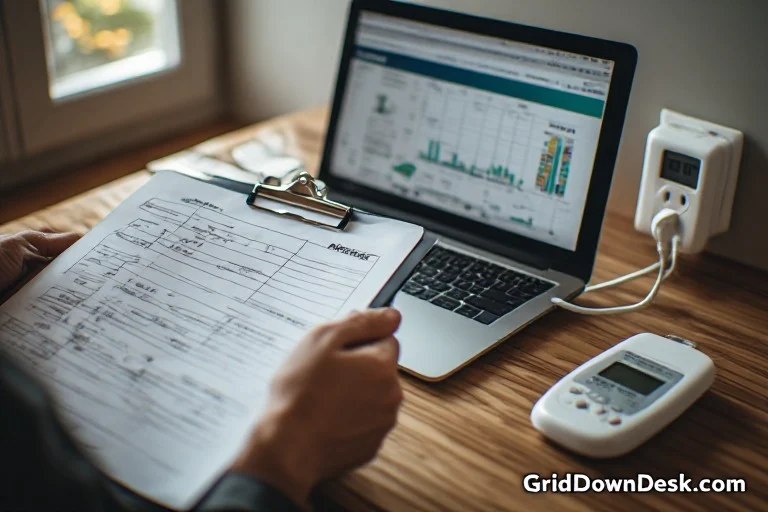
Check the manufacturer's label on the back or bottom of each device. If only Volts (V) and Amps (A) are listed, calculate Watts using the formula: Volts × Amps = Watts. (For a detailed guide on measuring exact device wattage with a plug-in meter, see our article on how to calculate your home office power needs.)
Step 3: Find the Surge Watts
For devices with motors, the surge wattage is typically 2 to 3 times the running wattage. If the label doesn't specify, multiply the running watts by 3 to be safe.
Step 4: Apply the Sizing Formula
Minimum Continuous Watts Needed = (Sum of all Running Watts) + (Highest single Surge Watt value).
Real-world sizing example
Let's calculate the needs for a basic home emergency setup:
| Device | Running Watts | Surge Watts |
|---|---|---|
| Wi-Fi Router (12V via mini UPS) | 10 W | 10 W |
| LED Lights (3 bulbs) | 30 W | 30 W |
| Laptop | 60 W | 60 W |
| Refrigerator (Modern, Energy Star) | 150 W | 1200 W |
| Sump Pump (1/3 HP) | 600 W | 1800 W |
| Totals | 850 W | 1800 W (Highest) |
Calculation: 850W (Total Running) + 1800W (Highest Surge) = 2650W.
To safely run this setup, you need a portable power station or generator with a continuous output of at least 2650W and a surge capacity of around 3000W+. A system rated for only 2000W continuous will fail the moment the sump pump tries to start.
The "Hidden" Loads to watch out for
When auditing your home, do not forget these often-overlooked power consumers:
- Garage door openers: ~500W running, ~1000W surge.
- Gas furnace blowers: ~400W-800W running (yes, gas furnaces need electricity).
- Well pumps: Highly variable, but often require 240V and massive surge capacity.
- CPAP machines with humidifiers: ~100W-150W continuous.
For more details on handling specific high-draw appliances, refer to our guide on powering AC units and space heaters.
Choosing the right tool for the job
Once you have your number, match it to the right technology:
- Under 1000W continuous: A high-quality pure sine wave portable power station (500Wh–1000Wh) or a line-interactive UPS.
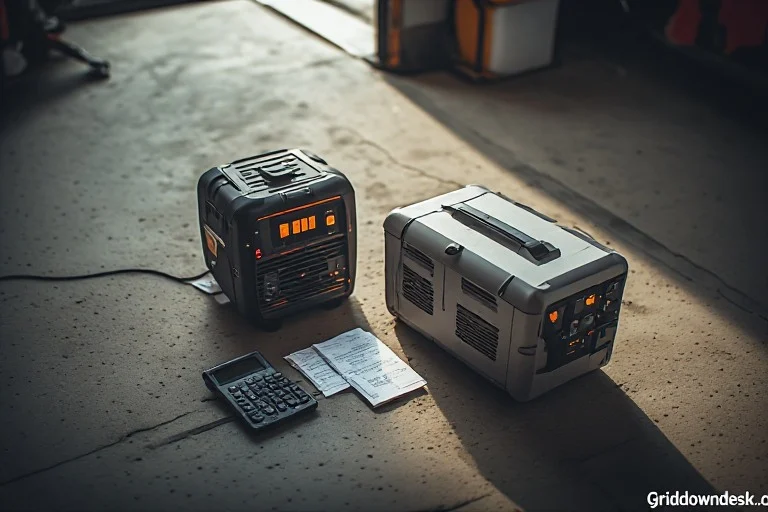
- 1000W – 3000W continuous: A large LiFePO4 portable power station (2000Wh+) or a dual-fuel inverter generator.
- Over 3000W continuous: A whole-home standby generator with an automatic transfer switch.
Remember, regardless of the system you choose, proper maintenance is key to ensuring it starts when needed. For comprehensive battery and equipment care instructions, see our guide on how to maintain and store your portable power station.
FAQ
Can I just add up the wattage of everything in my house? No. You will never run everything simultaneously during an outage, and sizing a system for "everything" is prohibitively expensive. Focus strictly on critical loads.
What if my power station has a lower continuous rating than my calculated need? You can practice "load shedding." For example, do not run the refrigerator and the sump pump at the exact same time. However, this requires manual intervention and is risky during a severe storm.
Do I need a pure sine wave inverter for this setup? Yes. As detailed in our guide on pure sine wave vs modified sine wave, running refrigerators, sump pumps, and furnace blowers on modified sine wave will cause motors to overheat and fail prematurely.
How accurate are plug-in power meters? They are highly accurate for resistive loads and average running watts. However, cheap meters may not capture micro-second surge watts. Always apply the 2x-3x multiplier for motorized devices to be safe.