Aquarium Battery Backup: Keep Fish Alive Guide
Short answer
A typical 20 to 40-gallon home aquarium requires 25W to 50W of continuous power to run its filter and heater. A compact 300Wh portable power station or a large 20,000mAh power bank can keep these critical systems running for 6 to 10 hours during a blackout, preventing dangerous oxygen depletion and temperature drops.
The biology reality of a power outage
When the grid fails, the immediate threat to your fish is not the lack of light (most fish do just fine in the dark). The real dangers are:
- Oxygen Depletion: The hang-on-back (HOB) or canister filter provides crucial surface agitation. When it stops, oxygen levels plummet rapidly, especially in warmer water.
- Temperature Swings: Without a heater, tropical fish tanks can drop several degrees in a few hours, causing severe stress and compromising the fish's immune systems.
- Ammonia Spikes: The beneficial bacteria in your filter media require a constant flow of oxygenated water. If the filter stops for more than 4-6 hours, these bacteria begin to die, leading to a toxic ammonia spike when the power returns.
Real-world power consumption breakdown
Aquarium equipment is generally very energy-efficient, but the load is continuous.
Typical power consumption:
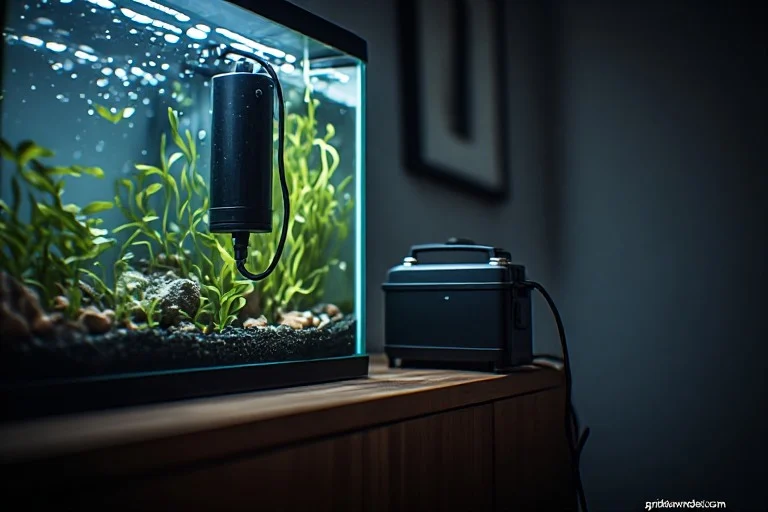
- Hang-on-Back (HOB) Filter: 5W – 15W (runs continuously).
- Canister Filter: 10W – 30W (runs continuously).
- Aquarium Heater (50W-100W rating): Draws 15W – 30W on average (it cycles on and off to maintain temperature, depending on room ambient temperature).
- Air Pump: 3W – 5W (runs continuously).
- LED Lighting: 10W – 20W (should be turned OFF during an outage to save power).
Total Average Load: 25W to 50W (assuming the light is off and the heater is cycling).
Calculating the aquarium runtime
To estimate how long your backup will last, we use the standard runtime formula. For a detailed breakdown of this math, see our guide on UPS runtime explained: VA vs watt-hours.
Runtime (hours) = (Battery Capacity in Wh × Efficiency) ÷ Average Load (W)
Note: We use 0.90 for efficiency if you are using a direct 12V DC connection (bypassing the AC inverter), which is highly recommended for aquarium gear.
Example Calculation:
- You have a 300Wh portable power station.
- Your filter and heater draw an average of 35W combined.
- Usable energy (DC connection): 300 Wh × 0.90 = 270 Wh.
- Runtime: 270 Wh ÷ 35W = ~7.7 hours.
If you use a high-capacity 20,000mAh (74Wh) USB power bank with a 12V USB-trigger cable for just the filter (10W), it will run for: (74 × 0.90) ÷ 10W = ~6.6 hours.
Best practices for aquarium blackout survival
- Use DC equipment if possible: Many modern aquarium filters and heaters are available in 12V DC versions. Plugging these directly into a power station's 12V car port eliminates the 10-15% energy loss of an AC inverter.
- Do not feed your fish: This is a critical rule. Uneaten food and increased biological waste will rapidly spike ammonia levels in a stagnant tank. Fish can easily go 3-5 days without food; they cannot go 3-5 hours without oxygen.
- Insulate the tank: If the outage is prolonged and the room is cold, wrap the outside of the aquarium in blankets or towels (leaving the top open for gas exchange). This acts as a thermal barrier, drastically reducing the heater's duty cycle.
- Manual surface agitation: If your battery dies, manually pour tank water back into the tank from a cup every 30-60 minutes. This simple action breaks the surface tension and replenishes dissolved oxygen.
Maintaining your backup readiness
Lithium batteries self-discharge over time. A power bank left in a drawer for six months may be completely dead when you need it. Check your aquarium backup battery every 2 to 3 months and top it up to 70-80%. For comprehensive battery care instructions, see our guide on how to maintain and store your portable power station.
FAQ
Can I use a standard computer UPS for my aquarium? Yes, a small 600VA pure sine wave UPS is actually an excellent choice for an aquarium. It provides instant switchover and usually has enough capacity to run a filter and heater for 2 to 4 hours, which is often enough to bridge short outages.
Should I leave the aquarium light on during a blackout? No. Turn off the LED lighting immediately. Fish do not need light during an outage, and the lights will unnecessarily drain your limited battery capacity.
Will a power outage crash my tank's nitrogen cycle? Not if you restore power (or battery backup) within 4 to 6 hours. The beneficial bacteria can survive a few hours without flow. If the outage lasts longer than 12 hours, you should test your water for ammonia and nitrite immediately upon restoring power and be prepared to do a partial water change.
Can I run the filter, heater, and lights all at once on a small battery? You can, but it is not recommended. Prioritize the filter and heater. The lights are the first thing you should sacrifice to extend the runtime of your critical life-support equipment.