Well Pump Battery Backup: Sizing & Runtime Guide
Short answer
Powering a well pump during a blackout is challenging due to massive motor startup surges and voltage requirements. A standard 120V shallow well jet pump (1/2 HP) requires at least 1000W continuous and 2000W surge capacity. However, most deep well submersible pumps require 240V AC, which standard portable power stations cannot provide without a specialized step-up inverter or a dedicated whole-home backup system.
The water outage reality check
When the grid fails, a house on municipal water might still have pressure in the pipes for a short time. A house on a private well loses water access instantly.
The well pump is an inductive load with one of the highest startup surges of any residential appliance. Furthermore, it operates on a "duty cycle" dictated by the pressure tank: it turns on at 30 PSI, runs until it hits 50 PSI, and turns off. During a blackout, if you use water normally, the pump will cycle frequently, rapidly draining your backup battery.
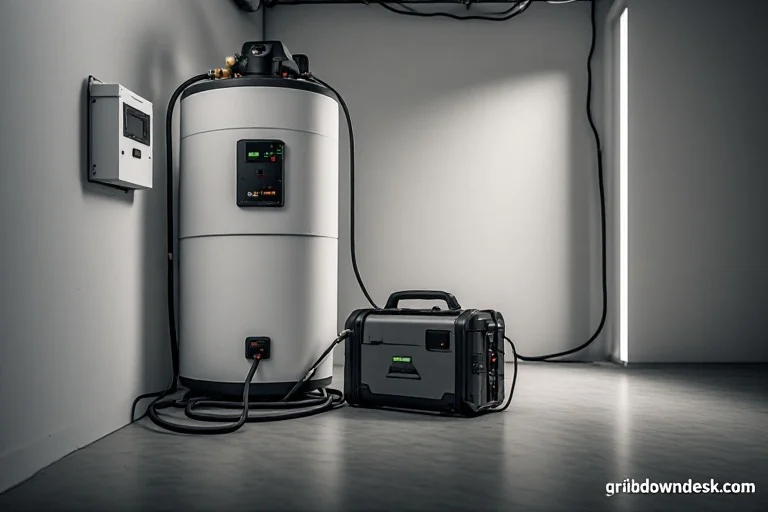
Real-world power consumption breakdown
You must identify your pump type and horsepower (HP) to size your backup correctly. Check the label on the control box or the pump itself.
Typical power consumption:
- 1/2 HP Shallow Well Jet Pump (120V): 1000W running, 2000W – 2500W startup surge.
- 3/4 HP Shallow Well Jet Pump (120V): 1500W running, 3000W – 3500W startup surge.
- 1/2 HP Submersible Pump (240V): 1000W running, 2000W – 2500W startup surge.
- 1 HP Submersible Pump (240V): 2000W running, 4000W – 5000W startup surge.
Critical Note: The vast majority of deep well submersible pumps are wired for 240V. Standard portable power stations only output 120V AC. You cannot plug a 240V pump into a 120V outlet using a simple adapter; it will not work and may damage the equipment.
Calculating the runtime
If you have a compatible 120V pump (or a specialized 240V backup system), we use the standard runtime formula adjusted for the pump's duty cycle. For the base math, see our guide on UPS runtime explained: VA vs watt-hours.
Runtime (hours) = (Battery Capacity in Wh × 0.85) ÷ (Running Watts × Duty Cycle)
Example Calculation (1/2 HP Shallow Jet Pump):
- You have a 2000Wh portable power station (120V output).
- Pump draws 1000W when running.
- During an outage, you conserve water, so the pump runs only 20% of the time (0.20 duty cycle).
- Effective average draw: 1000W × 0.20 = 200W.
- Usable energy: 2000 × 0.85 = 1700 Wh.
- Runtime: 1700 Wh ÷ 200W = 8.5 hours.
If you use water heavily (60% duty cycle), that same battery will deplete in under 3 hours.
Solutions for 240V Deep Well Pumps
Since standard power stations are 120V, homeowners with 240V submersible pumps have three realistic options:
- Dual 120V Power Stations with a Transfer Switch: Some advanced setups allow wiring two 120V outputs together, but this is complex and requires a licensed electrician.
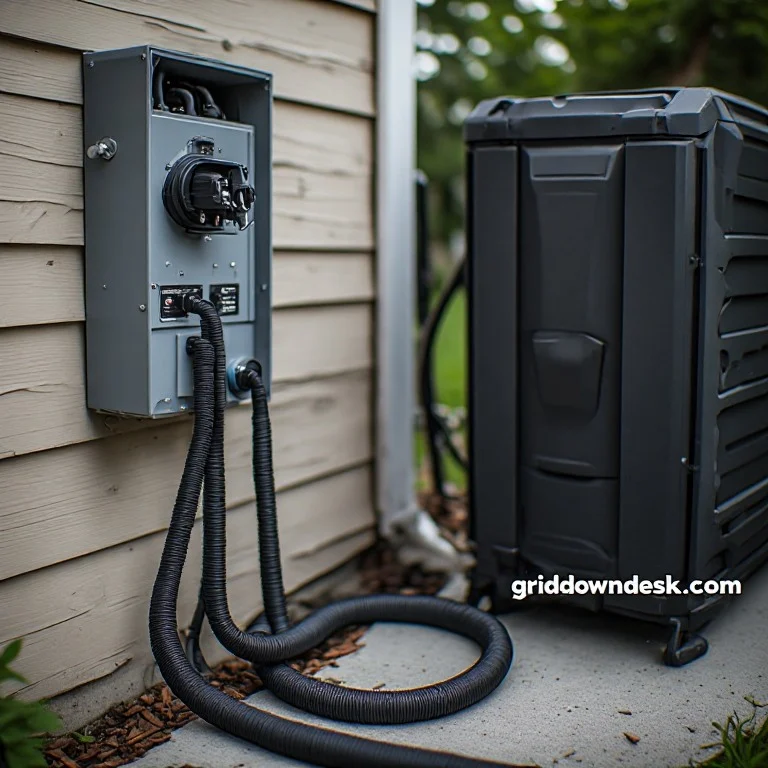
- A Dedicated 240V Inverter System: Installing a heavy-duty pure sine wave inverter (3000W+) wired directly to a large 48V battery bank or a whole-home backup system.
- A Standby Generator: For 240V well pumps, a propane or natural gas standby generator with an automatic transfer switch remains the most reliable and code-compliant solution. For safe installation principles, see our guide on safe power station home connection.
Strategies to conserve water and battery
If you are running a well pump on limited battery power, every gallon counts:
- Batch your water usage: Do not run the dishwasher, washing machine, or take long showers during an outage. Use disposable plates and pre-filled water jugs for drinking.
- Increase the pressure switch differential: If you are technically inclined, adjusting the pressure switch to a wider range (e.g., 30/50 PSI to 20/60 PSI) reduces the number of times the pump cycles on and off, saving massive amounts of startup surge energy. (Warning: Consult a professional before adjusting pressure switches).
- Have a manual backup: Install a manual hand pump on your well casing or keep a gravity-fed water storage tank (like a WaterBrick or large barrels) as a zero-electricity fallback.
Maintaining your water security readiness
Well pump control boxes contain capacitors and relays that can degrade. Ensure your backup power solution is kept in a dry, temperature-controlled environment. Lithium batteries self-discharge, so check the charge level monthly. For comprehensive battery care instructions, see our guide on how to maintain and store your portable power station.
FAQ
Can I use a step-up transformer to run my 240V pump from a 120V power station? Technically yes, but it is highly discouraged. A transformer that steps 120V up to 240V will double the amperage draw on the 120V side. A 1000W 240V pump will draw over 2000W from the 120V inverter, instantly tripping the overload protection of almost all consumer power stations.
Will a modified sine wave inverter work for a well pump? No. Well pump motors are highly inductive. A modified sine wave will cause the motor to overheat, hum loudly, and potentially burn out the windings or the control box capacitors. Pure sine wave is mandatory.
Can I run my well pump and my sump pump on the same backup system? Only if the system is massive (e.g., a whole-home generator or a 10kWh+ battery bank). Both are high-surge inductive loads. Running them simultaneously on a standard portable power station will guarantee an overload trip.
How do I know if my well pump is 120V or 240V? Check the circuit breaker in your main electrical panel. If it is a single-pole breaker (taking up one slot), it is 120V. If it is a double-pole breaker (taking up two slots), it is 240V.