CPAP Machine Battery Backup: Sizing & Runtime Guide
Short answer
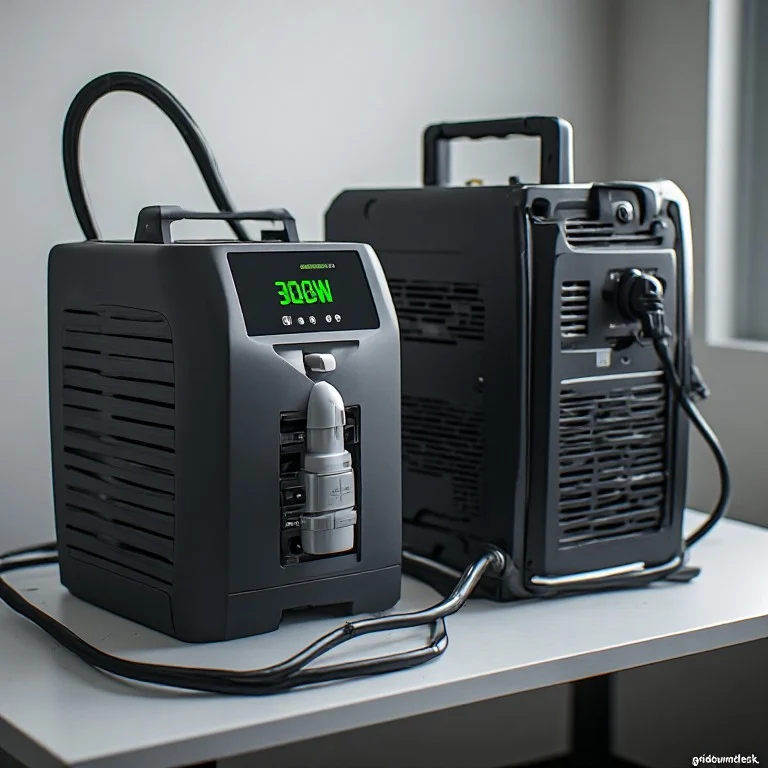
To power a CPAP machine during a blackout, a portable power station with at least 300Wh of capacity is recommended for a full 8-hour night. However, the critical factor is the heated humidifier: using it can triple your power consumption. By switching to a dedicated 12V DC cable (bypassing the AC inverter) and turning off the heated tube, a 300Wh power station can reliably run a standard CPAP for 2 to 3 nights.
The humidifier reality check
The biggest mistake CPAP users make during a power outage is running their device exactly as they do at home, with the heated humidifier and heated tube turned on high.
The CPAP motor itself is highly efficient, drawing only 30W to 60W. However, the heating element in the humidifier is a resistive load that draws a continuous 70W to 100W+ just to boil water. Turning off the humidifier is the single most effective way to extend your battery life, often doubling or tripling your runtime without compromising the core therapeutic pressure of the machine.
Real-world CPAP power consumption
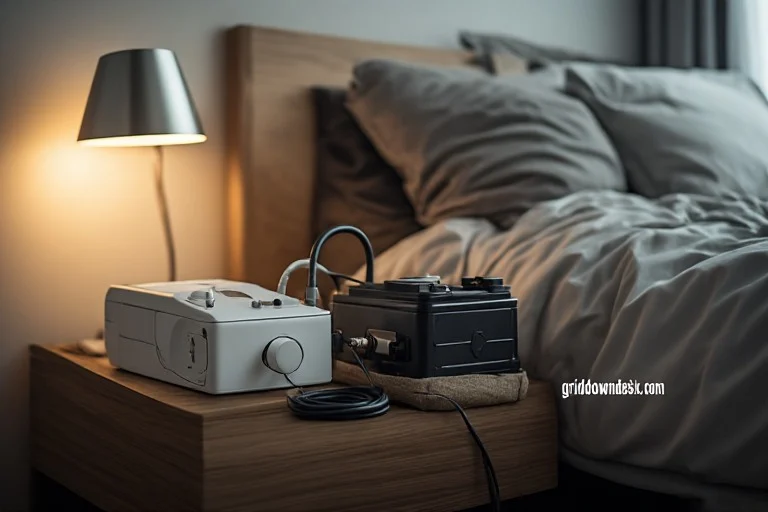
Power draw varies significantly based on your pressure settings (cmH2O) and accessory usage.
Typical power consumption (8-hour night):
- CPAP Motor Only (No Humidifier): 30W – 50W average (240Wh – 400Wh per night).
- CPAP + Standard Heated Humidifier (Medium setting): 60W – 90W average (480Wh – 720Wh per night).
- CPAP + Heated Humidifier + Heated Tube (High setting): 100W – 130W+ average (800Wh – 1000Wh+ per night).
Note: Higher prescribed pressure settings require the motor to work harder, slightly increasing the baseline wattage.
Calculating your 8-hour sleep runtime
To ensure you wake up with power to spare, we calculate the total energy needed for a full night. For the foundational math, see our guide on home backup power calculator sizing.
Required Capacity (Wh) = Average Wattage × 8 hours ÷ Efficiency
Note: If using a 12V DC cable, efficiency is ~0.95. If using the standard AC wall plug, efficiency drops to ~0.85 due to inverter loss.
Example Calculation (Optimized Setup):
- CPAP motor only (no humidifier): 40W average.
- Using a 12V DC cable (0.95 efficiency).
- Required capacity for 1 night: (40W × 8h) ÷ 0.95 = ~337 Wh.
A standard 500Wh portable power station will easily provide 1.5 to 2 full nights of sleep in this optimized configuration. If you must use the humidifier, that same 500Wh station will only last about 5 to 6 hours, requiring a larger 1000Wh+ unit for a full night.
Step-by-step setup for maximum efficiency
Step 1: Acquire a 12V DC CPAP cable. Do not use the standard AC power brick. Purchase a dedicated DC cable compatible with your specific CPAP model (e.g., ResMed, Philips Respironics). These cables plug directly into the 12V "cigarette lighter" port of your power station.
Step 2: Configure your CPAP settings. Before bed, navigate to your machine's clinical or user menu. Turn the "Humidifier" to "Off" or "Passive" (unheated water only). Turn "Heated Tube" to "Off".
Step 3: Enable "Eco Mode" or "Airplane Mode". If your CPAP has built-in Wi-Fi or cellular connectivity for data tracking, disable it during the outage. Transmitting data drains the battery unnecessarily.
Step 4: Insulate the air tube. To prevent "rainout" (condensation in the tube due to the lack of a heated hose), wrap the standard tube in a CPAP tube cover or a simple fleece sock. This traps ambient heat and keeps the airflow comfortable.
Maintaining your medical backup readiness
A CPAP backup is only as reliable as its battery health. Lithium batteries self-discharge over time. To ensure your power station is ready for an unexpected outage, check its charge level every 2 to 3 months and top it up to 60-70%. For comprehensive battery care instructions, see our guide on how to maintain and store your portable power station.
FAQ
Can I use a modified sine wave inverter for my CPAP? It is strongly discouraged. While some older CPAP models might tolerate it, modern machines with sensitive electronics and advanced motors can be damaged by the harmonic distortion of a modified sine wave. Always use a pure sine wave power source or direct 12V DC.
Can I take my portable power station on an airplane for travel? Yes, if it is under the FAA limit of 100Wh (or up to 160Wh with airline approval). Most "travel-sized" CPAP power banks are designed specifically to meet this requirement. Always check with your airline in advance and carry the device in your carry-on luggage.
Will turning off the humidifier make the air too dry? It may feel slightly drier than usual. To compensate, ensure you are well-hydrated before bed, and consider placing a bowl of water in the bedroom to add passive ambient humidity to the room.
Can I recharge the power station with solar while using the CPAP at night? No, solar charging requires daylight. However, you can recharge the station during the day using solar panels to prepare for the following night. For sizing your solar array, refer to our solar panel sizing calculator guide.