LiFePO4 vs NMC Battery: Power Station Guide
Short answer
For long-term home backup and frequent use, a power station with a Lithium Iron Phosphate (LiFePO4) battery is the superior choice, offering 3,000+ cycles and exceptional thermal stability. For occasional camping or situations where minimal weight is the absolute priority, a Nickel Manganese Cobalt (NMC) lithium-ion battery is acceptable, providing higher energy density at a lower upfront cost, but with a shorter lifespan of 500–800 cycles.
The chemistry reality: Not all "Lithium" is equal
Marketing materials often vaguely state "Lithium-ion battery," hiding the crucial difference in cell chemistry. The two dominant types in portable power stations behave very differently under stress, age, and heavy loads.
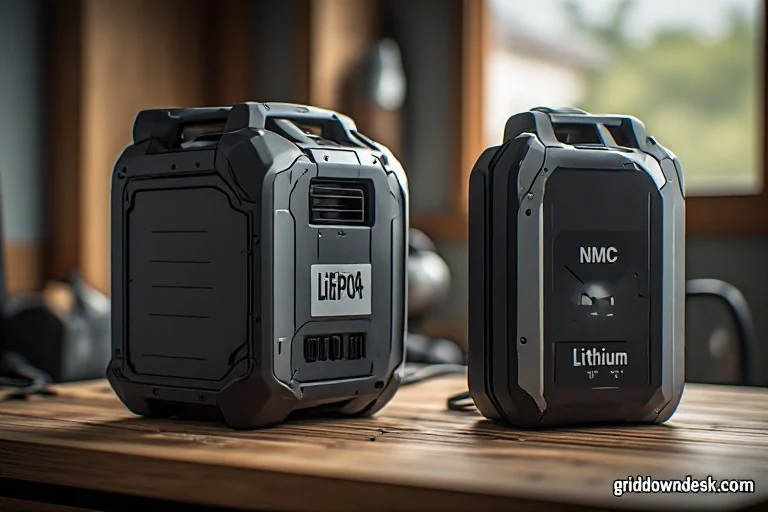
- NMC (Nickel Manganese Cobalt): The traditional lithium-ion chemistry found in smartphones, laptops, and older power stations. It packs a lot of energy into a small, light package but is more sensitive to heat, deep discharges, and has a shorter overall lifespan.
- LiFePO4 (Lithium Iron Phosphate): A newer, inherently safer chemistry. The iron-phosphate bond is much more stable than the cobalt-oxide bond in NMC. It is heavier and slightly larger for the same capacity, but it can withstand thousands of charge cycles and extreme temperatures without degrading or posing a fire risk.
Real-world comparison: LiFePO4 vs NMC
| Feature | LiFePO4 (LFP) | NMC (Lithium-ion) |
|---|---|---|
| Cycle Life (to 80% capacity) | 3,000 – 5,000+ cycles | 500 – 800 cycles |
| Thermal Runaway Risk | Extremely Low (stable up to 270°C) | Moderate (requires strict BMS monitoring) |
| Weight per 1000Wh | ~10–12 kg (Heavier) | ~7–9 kg (Lighter) |
| Cold Weather Charging | Poor (must be >0°C / 32°F) | Better (can charge down to -10°C / 14°F) |
| Upfront Cost | Higher (but dropping rapidly) | Lower |
| Best Use Case | Home backup, daily use, solar integration | Occasional camping, backpacking, tight budgets |
Calculating the true cost of ownership
The higher upfront price of a LiFePO4 power station is often justified by its lifespan. To understand the real value, we calculate the Cost Per Cycle.
Formula: Cost Per Cycle = Purchase Price ÷ Expected Cycle Life
Example Calculation:
- NMC Station: Costs $500, rated for 500 cycles.
$500 ÷ 500 = $1.00 per cycle.
- LiFePO4 Station: Costs $800, rated for 3,000 cycles.
$800 ÷ 3,000 = $0.26 per cycle.
Over a 5-year period of regular use (e.g., weekly blackouts, regular solar cycling, or frequent camping), the LiFePO4 unit is dramatically cheaper to own, even before factoring in the cost of replacing an NMC battery pack. For a detailed guide on sizing your investment, refer to our home backup power calculator sizing guide.
Best practices for maximizing battery lifespan
Regardless of chemistry, proper care extends the life of your investment.
For LiFePO4:
- Avoid freezing charge: Never charge a LiFePO4 battery when its internal temperature is below 0°C (32°F). Charging frozen LiFePO4 cells causes permanent, irreversible damage (lithium plating). Many modern units have built-in heaters to prevent this, but verify your model's specs.
- Storage: Store at 50%–70% charge. LiFePO4 is very stable, but long-term storage at 100% can still cause minor capacity fade over years.
For NMC:
- Avoid deep discharges: Try not to let an NMC battery drop below 20%. Frequent 100% to 0% cycles will rapidly degrade its capacity.
- Keep it cool: Heat is the #1 enemy of NMC chemistry. Never leave an NMC power station in a hot car trunk or in direct, blazing sunlight for extended periods.
For comprehensive, universal battery care instructions, see our foundational guide on how to maintain and store your portable power station.
FAQ
Can I upgrade my old NMC power station to LiFePO4? No. The battery management system (BMS), physical dimensions, and voltage curves are completely different. You must purchase a new unit designed for LiFePO4 chemistry.
Is LiFePO4 safe to keep inside my bedroom or living room? Yes. LiFePO4 is widely considered the safest commercially available lithium battery chemistry. It does not emit toxic fumes and is highly resistant to thermal runaway, making it ideal for indoor home backup.
Why do some manufacturers still use NMC? NMC offers higher energy density (more Wh per kilogram). For ultralight backpacking power banks or budget-conscious consumers who only need power a few times a year, NMC remains a viable, cost-effective option.
How do I know which chemistry my power station has? Reputable manufacturers proudly advertise "LiFePO4" or "LFP" on the front of the box as a premium feature. If the specs only say "Lithium-ion" or "Li-ion" without specifying LFP, it is almost certainly NMC chemistry.