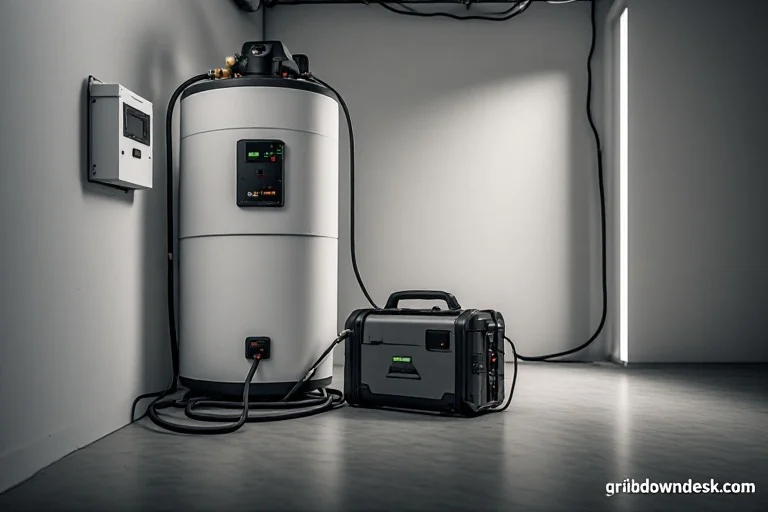
Power Backup for Home Security: Cameras and NVR Runtime
Short answer
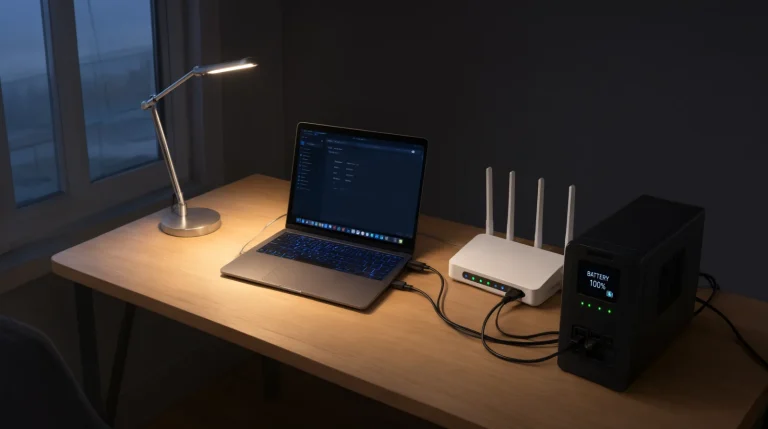
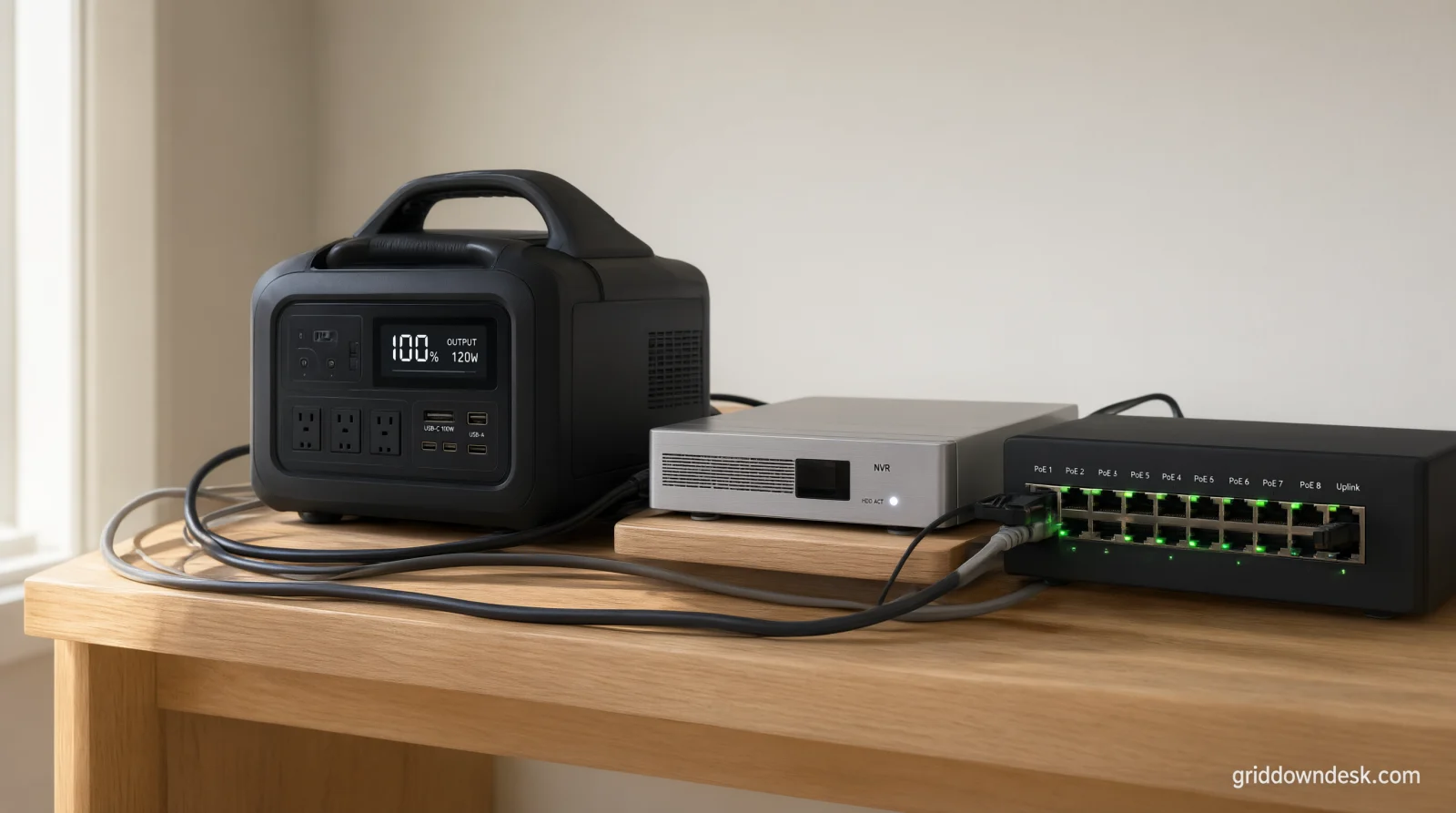
A standard 4-camera PoE security system (NVR plus four cameras) draws about 40 to 60 watts. To keep this system running for 8 hours during a blackout, you need a power backup with at least 450 to 500 watt-hours (Wh) of usable capacity, such as a mid-sized portable power station or a dedicated 12V battery bank.
Why a standard UPS often fails for security systems
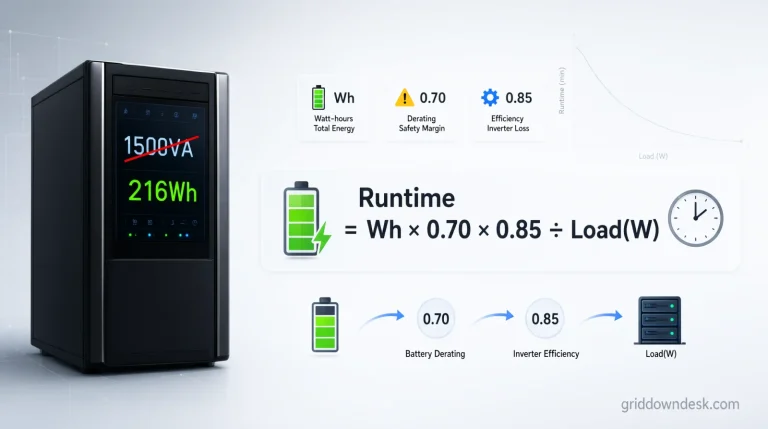
Many homeowners try to plug their NVR and PoE switch into a cheap, entry-level UPS. This usually leads to two problems. First, the battery capacity in a standard 600VA UPS is tiny (often just one 12V 7Ah battery, equaling 84Wh), which will only keep a 50W security system alive for about one hour.
Second, many budget UPS units use a "simulated" or "stepped" sine wave inverter. Sensitive electronics like PoE switches and NVR power supplies can overheat, buzz, or even shut down unexpectedly when fed a simulated sine wave. For reliable security backup, you need a "pure sine wave" output.
The calculation formula
To size your backup correctly, use this straightforward formula:
Required Capacity (Wh) = (Total System Wattage × Desired Hours) ÷ Inverter Efficiency
- Total System Wattage: Add the maximum draw of the NVR and all connected cameras.
- Desired Hours: How long you need the system to survive a typical outage (e.g., 8 hours).
- Inverter Efficiency: Account for energy lost during DC-to-AC conversion. For pure sine wave inverters, assume 85% (0.85).
Real-world capacity requirements
Based on average power draws (15–25W for an NVR, and 5–10W per PoE camera), here is what you need to maintain an 8-hour runtime:
| System Setup | Estimated Load | Energy Needed (8h) | Recommended Backup Size |
|---|---|---|---|
| 2 Cameras + NVR | 30 W | 240 Wh | 300 Wh portable station |
| 4 Cameras + NVR | 50 W | 400 Wh | 500 Wh portable station |
| 8 Cameras + NVR | 90 W | 720 Wh | 1000 Wh portable station |
These are calculated estimates based on manufacturer specifications. Actual draw may be slightly lower if cameras are in night mode without active IR illuminators, or higher if all IR lights are on full brightness.
Practical setup tips
Use a PoE switch instead of individual injectors. A single 4-port or 8-port PoE switch is much more efficient than plugging 4 separate power adapters into a power strip. It consolidates the load and makes cable management cleaner.
Verify the pure sine wave requirement. Check the manual of your NVR and PoE switch. If they specify "pure sine wave only," do not compromise. Portable power stations and higher-end UPS units clearly advertise this feature.
Consider a 12V DC direct connection. If your NVR supports 12V DC input, you can bypass the power station's AC inverter entirely using a 12V cigarette lighter adapter. This eliminates the 15% inverter efficiency loss, extending your runtime significantly. For more details on calculating exact battery needs, see our guide on UPS runtime explained: VA vs watt-hours.
Test your setup quarterly. Plug the system into the backup power source and unplug it from the wall for 10 minutes. Verify that the NVR boots up correctly and all cameras reconnect without manual intervention.
FAQ
Can I use a solar panel to keep the security system running indefinitely? Yes. If your system draws 50W, it consumes about 400Wh over 8 hours. A single 100W solar panel receiving 4 peak sun hours will generate roughly 300–350Wh per day, which can sustain a light-load system or significantly extend a larger battery's runtime.
Will the cameras lose their settings when the power switches to battery? No. The transition from wall power to battery backup is seamless for the devices. The NVR and cameras will continue recording as if nothing happened, provided the backup source can handle the initial power surge.
How do I find the exact wattage of my specific cameras? Check the label on the PoE injector or the camera's technical specifications sheet. Look for "Max Power Consumption" or "PoE Budget". If it lists volts and amps (e.g., 12V 1A), multiply them to get watts (12W).
Is it safe to leave the power station plugged in all the time? Yes. Modern portable power stations with LiFePO4 batteries have built-in Battery Management Systems (BMS) that stop charging when full and can safely remain plugged in as a permanent passive backup.