Sewage Ejector Pump Blackout Power Guide
Short answer
To prevent basement flooding during a blackout, a sewage ejector pump requires a pure sine wave UPS or portable power station with a high surge capacity. A typical 1/3 HP pump draws 400W continuously but spikes to 1200W–1500W at startup. A 1/2 HP pump can surge up to 2000W. You need a backup unit rated for at least 1500W to 2000W continuous output to handle these inductive motor surges safely without tripping the overload protection.
The flooding reality
Unlike a sump pump that handles relatively clean groundwater, a sewage ejector pump (or macerating pump like a Saniflo) handles wastewater from toilets, sinks, and showers located below the main sewer line.
When the power fails, this pump stops immediately. Depending on household usage, the basin can overflow in as little as 2 to 4 hours, causing catastrophic, unsanitary flooding. Because this is a critical, high-consequence load, relying on a generator that requires manual pull-starting in the dark is a significant risk. An automatic, battery-backed solution is highly recommended.
Real-world power consumption breakdown
Sewage pumps are heavy-duty inductive loads. Their power draw is not constant; it is characterized by a massive, brief spike required to overcome the static friction of the impeller and push water vertically through the check valve.
Typical power consumption:
- 1/3 HP Sewage Pump: 400W running, 1200W – 1500W startup surge.
- 1/2 HP Sewage/Macerating Pump: 600W running, 1800W – 2000W startup surge.
- Duty Cycle: Varies by usage. In a residential setting, the pump may only run for 1 to 2 minutes per hour (2-3% duty cycle), but the surge happens every single time it activates.
Critical Note: The continuous wattage rating of your backup unit is less important than its surge (peak) wattage rating. If the surge rating is too low, the unit will shut down instantly when the float switch triggers.
Calculating your pump runtime
Because the pump runs intermittently, we calculate runtime based on an estimated duty cycle. For the foundational math, see our guide on home backup power calculator sizing.
Runtime (hours) = (Usable Battery Wh) ÷ (Running Watts × Duty Cycle)
Example Calculation (1/2 HP Pump on a 1000Wh Station):
- Running load: 600W.
- Estimated duty cycle during moderate use: 5% (0.05).
- Average continuous draw: 600W × 0.05 = 30W.
- Usable energy (at 85% inverter efficiency): 1000 Wh × 0.85 = 850 Wh.
- Runtime: 850 Wh ÷ 30W = ~28 hours.
This provides more than a full day of protection, assuming the backup unit's surge rating (e.g., 2000W+) is high enough to handle the 1800W startup spike without tripping.
Best practices for sewage pump backup
- Pure Sine Wave is Mandatory: Macerating pumps and standard sewage motors contain sensitive electronics and inductive windings. A modified sine wave inverter will cause the motor to overheat, hum loudly, and potentially burn out the internal capacitors or control board.
- Dedicated Circuit: Plug only the sewage pump into this specific backup unit. Do not share it with refrigerators or freezers. The combined surge of two motors starting simultaneously will guarantee an overload trip.
- Test the Float Switch: Once a month, manually lift the float switch while the pump is on backup power. Verify that the pump activates smoothly, the backup unit does not beep an overload warning, and the water evacuates properly.
- Install a High-Water Alarm: As a failsafe, install a battery-operated high-water alarm in the basin. If the backup power fails or the pump clogs, this alarm will alert you before the basement floods.
Maintaining your flood prevention system
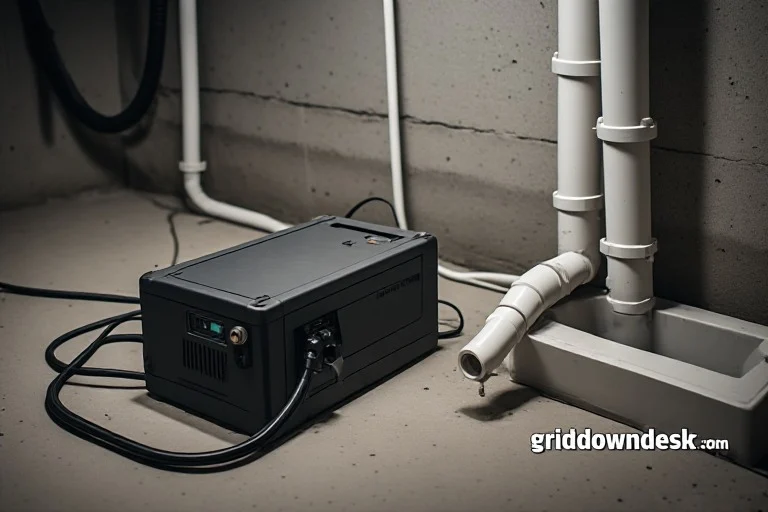
A backup unit sitting in a basement is subject to humidity and temperature swings. Ensure the unit is placed on a raised platform (not directly on a potentially damp concrete floor) and has at least 6 inches of clearance on all sides for cooling fans. For comprehensive battery care instructions, see our guide on how to maintain and store your portable power station.
FAQ
Can I use a standard sump pump backup system for a sewage pump? No. Sump pump backup systems are typically designed for lower-wattage, clean-water pumps (often 12V DC). Sewage and macerating pumps require 120V AC and have much higher startup surges that will destroy a standard sump pump backup controller.
Why does my power station shut off exactly when the pump turns on? The startup surge of the pump exceeded the peak wattage limit of the power station's inverter. Even if the continuous rating is sufficient, the micro-second spike triggers the short-circuit/overload protection. You must upgrade to a unit with a higher surge rating.
Will the pump automatically resume when grid power returns? Yes. A line-interactive UPS or a power station in passthrough mode will seamlessly switch back to grid power. The pump's float switch will continue to operate normally without any manual reset required.
Can I hardwire the backup directly to the pump? For permanent installations, a licensed electrician can wire a dedicated UPS or inverter system directly to the pump's junction box, eliminating the need for wall outlets and extension cords. This is the most reliable and code-compliant method.