Aquarium & Reef Tank Blackout Power Guide
Short answer
To keep a tropical aquarium or reef tank alive during a blackout, you must power the return pump, heater, and (for reef tanks) the protein skimmer. A typical 50-gallon setup draws 100W to 200W continuously, primarily due to the heater. A 500Wh pure sine wave portable power station or UPS will keep this critical equipment running for 2 to 4 hours. For longer outages, insulating the tank and temporarily disabling non-essential equipment (like LED lights or wavemakers) is mandatory to extend battery runtime.
The "Rapid Collapse" reality
Unlike a refrigerator that retains cold for hours, an aquarium is a delicate, closed-loop biological system. When the power fails, three critical failures occur simultaneously:
- Filtration stops: Beneficial bacteria in the filter media begin to die from oxygen deprivation within 1–2 hours, risking an ammonia spike.
- Temperature drops: Tropical fish and corals require stable temperatures (75°F–80°F / 24°C–27°C). Without a heater, water temperature can drop dangerously fast, especially in winter.
- Oxygen depletion: Surface agitation from the return pump or wavemakers ceases, causing dissolved oxygen levels to plummet, suffocating livestock.
Because of this narrow survival window, an aquarium is a "critical load" that demands immediate, reliable backup power.
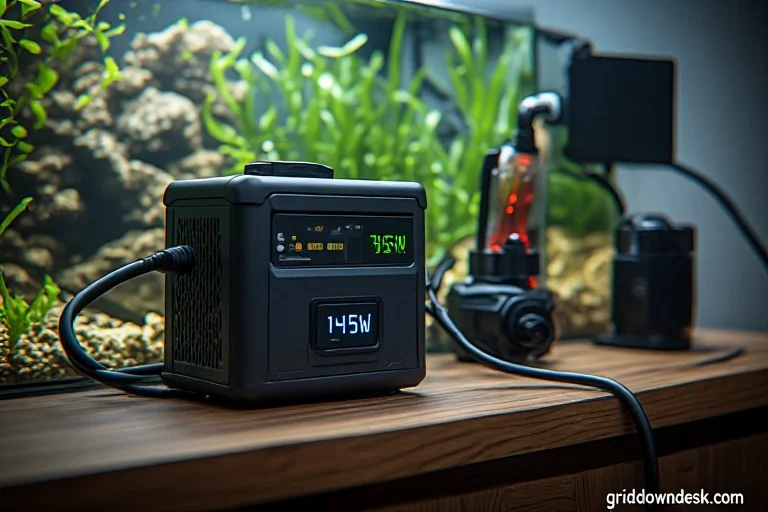
Real-world aquarium power consumption
Aquarium equipment is a mix of resistive (heater) and inductive (AC pump) loads. Always check the wattage labels on your specific gear.
Typical power consumption (50–75 gallon setup):
- Submersible Heater: 100W – 200W (cycles on and off, but draws max wattage when active).
- Return Pump (AC): 20W – 40W continuous.
- Protein Skimmer (Reef): 15W – 30W continuous.
- Wavemaker / Powerhead: 10W – 25W each.
- Total Critical Load: 130W to 250W (assuming the heater is actively running).
Note: DC pumps (like modern EcoTech or Sicce pumps) are significantly more efficient, often drawing 40%–60% less power than equivalent AC pumps, and are highly recommended for blackout resilience.
Calculating your tank's survival runtime
To estimate how long your backup will last, we calculate based on the worst-case scenario: the heater running continuously (e.g., during a cold winter night). For foundational math, see our guide on home backup power calculator sizing.
Runtime (hours) = (Usable Battery Wh) ÷ Total Critical Load (W)
Example Calculation (Winter Outage):
- Total critical load: Heater (150W) + Return Pump (30W) + Skimmer (20W) = 200W.
- Power source: 1000Wh pure sine wave power station.
- Usable energy (at 85% inverter efficiency): 1000 Wh × 0.85 = 850 Wh.
- Runtime: 850 Wh ÷ 200W = ~4.25 hours.
While 4 hours seems short, it is enough time to bridge the gap until a generator starts, or to buy time to implement emergency insulation measures.
Best practices for aquarium blackout survival
- Pure Sine Wave is Mandatory: AC return pumps and protein skimmers use inductive motors. A modified sine wave inverter will cause these pumps to overheat, buzz loudly, and potentially burn out, destroying your equipment and endangering the tank.
- Insulate the Tank Immediately: If the outage is prolonged, wrap the outside of the aquarium in blankets, towels, or reflective emergency foil. This traps existing heat and drastically reduces the heater's duty cycle, potentially doubling your battery runtime.
- Disable Non-Essentials: Turn off LED lighting, UV sterilizers, and wavemakers immediately. They are not critical for short-term survival and only drain the battery.
- Manual Aeration: If battery power is critically low and you must turn off the return pump, manually agitate the water surface with a clean cup every 30 minutes, or use a small, battery-powered air pump (which draws only 2W–3W) to maintain oxygen levels.
Maintaining your aquatic readiness
Saltwater environments are highly corrosive. Regularly inspect the power cords and plugs of your aquarium equipment for green/white corrosion, which increases resistance and fire risk. Keep your backup power station in a dry, elevated location away from potential spills. For comprehensive battery care instructions, see our guide on how to maintain and store your portable power station.
FAQ
Can I use a small 12V battery and inverter for my aquarium? Yes, but only if the inverter is pure sine wave. Alternatively, upgrading to 12V or 24V DC aquarium pumps and heaters allows you to bypass the inverter entirely, gaining 15%–20% more runtime from the same battery.
Will the temperature drop kill my fish in 2 hours? Most healthy tropical fish can survive a gradual temperature drop of 5°F–8°F over a few hours. The immediate danger is oxygen depletion, not cold. Prioritize surface agitation over heating if battery power is severely limited.
Can I run the heater on a lower wattage setting? No. Submersible heaters are binary; they are either fully ON (drawing their rated wattage) or OFF. You cannot "dim" them. To save power, you must rely on tank insulation to reduce how often the heater cycles on.
Is a UPS or a portable power station better for an aquarium? A portable LiFePO4 power station is generally superior. Standard UPS units are designed for 5–15 minute computer shutdowns and will deplete in under 30 minutes under a 200W aquarium load. A 500Wh+ power station provides the hours of runtime actually needed.