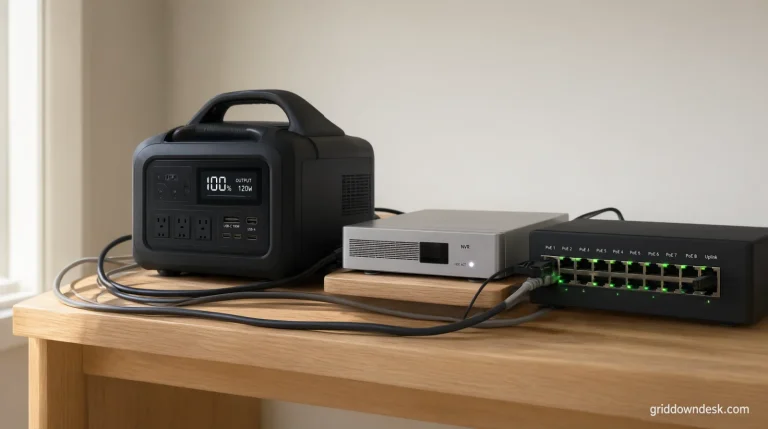
Inverter Sizing Calculator: Continuous vs. Surge Watts Guide
Short answer
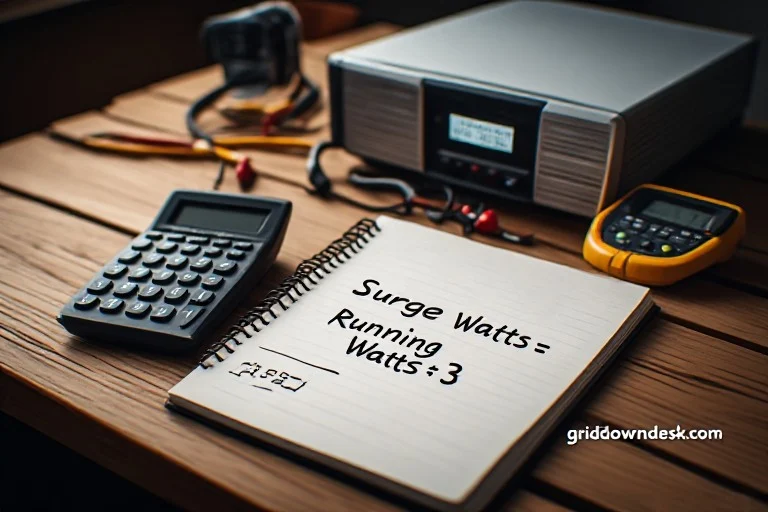
To correctly size a power inverter, you must calculate two values: Continuous Watts (the sum of all running appliances) and Surge Watts (the sum of running watts plus the highest single startup spike). Inductive loads like refrigerators, well pumps, and power tools require 2 to 3 times their rated running wattage for a fraction of a second at startup. Always choose an inverter with a surge rating that exceeds your maximum calculated spike, and a continuous rating that exceeds your total running load by at least 20%.
The "Nameplate" illusion
A common and costly mistake is reading the wattage label on an appliance and buying an inverter that matches that number exactly.
For resistive loads (like incandescent light bulbs or space heaters), running watts and startup watts are identical. However, for inductive loads (anything with a motor or compressor), the motor must overcome static inertia to start spinning. This requires a massive, brief burst of energy called "Locked Rotor Amps" (LRA) or surge wattage. If your inverter's peak surge rating is lower than this spike, it will instantly trigger overload protection and shut down, even if the continuous wattage seems sufficient.
Real-world appliance surge breakdown
Always check the appliance's specification plate for "RLA" (Rated Load Amps) and "LRA" (Locked Rotor Amps). If only watts or amps are listed, use these empirical multipliers:
| Appliance Type | Estimated Running Watts | Estimated Surge Watts (Startup) | Multiplier |
|---|---|---|---|
| Refrigerator / Freezer | 150W – 300W | 900W – 1,200W | 3x – 4x |
| Well Pump (1/2 HP) | 1,000W | 2,500W – 3,000W | 2.5x – 3x |
| Microwave Oven | 1,000W – 1,500W | 1,500W – 2,000W | 1.5x |
| Circular Saw / Power Tool | 1,200W | 2,400W – 3,000W | 2x – 2.5x |
| Laptop / Electronics | 60W – 100W | 60W – 100W | 1x (Resistive/DC) |
Note: Modern inverter-driven appliances (like variable-speed refrigerators or well pumps with soft starters) have significantly lower surge requirements, sometimes as low as 1.2x running watts.
Step-by-step inverter sizing formula
Follow this exact process to determine the minimum inverter size for your needs. For broader home energy calculations, see our guide on home backup power calculator sizing.
Step 1: Calculate Total Continuous Watts Add up the running watts of all devices you plan to operate simultaneously. Total Continuous = Device A + Device B + Device C...
Step 2: Identify the Largest Surge Find the single appliance with the highest difference between its surge watts and running watts. Max Surge Addition = (Highest Appliance Surge Watts) - (Highest Appliance Running Watts)
Step 3: Calculate Required Inverter Ratings
- Minimum Continuous Rating: Total Continuous Watts × 1.20 (20% safety headroom).
- Minimum Surge Rating: Total Continuous Watts + Max Surge Addition.
Example Calculation: You want to run a Refrigerator (200W running, 1000W surge) and a Router (10W running, 10W surge).
- Total Continuous: 200W + 10W = 210W.
- Max Surge Addition: 1000W (Fridge) – 200W (Fridge) = 800W.
- Required Continuous: 210W × 1.20 = 252W.
- Required Surge: 210W + 800W = 1,010W.
Result: You need an inverter rated for at least 300W continuous and 1,200W surge. A standard 500W/1000W inverter would fail; a 1000W/2000W inverter is the safe choice.
Best practices for inverter selection
- Pure Sine Wave is Mandatory for Motors: As detailed in our guide on pure sine wave vs modified sine wave, modified sine wave inverters cause inductive motors to run hotter, less efficiently, and with higher startup current spikes, increasing the risk of overload.
- Never Max Out the Inverter: Running an inverter at 95-100% of its continuous capacity generates extreme heat, triggering thermal throttling or permanent damage. Always maintain at least a 20% buffer.
- Mind the Wire Gauge: A correctly sized inverter is useless if connected with thin wires. High amperage at low voltage (12V/24V) requires thick, short cables (e.g., 2 AWG or 4 AWG) to prevent voltage drop and fire hazards.
Maintaining your power equipment
Inverters have cooling fans that can become clogged with dust, reducing their ability to handle surge loads without overheating. Vacuum the vents every 6 months. Ensure your connected batteries are healthy and fully charged, as a weak battery will sag in voltage under surge load, causing the inverter to trigger a "low battery" shutdown prematurely. For comprehensive battery care instructions, see our guide on how to maintain and store your portable power station.
FAQ
Can I use a power station instead of a standalone inverter? Yes. Modern portable power stations have built-in pure sine wave inverters. The same sizing rules apply: check both the "Continuous Output" and "Surge/Peak Output" specifications in the manual before plugging in motorized appliances.
What happens if I exceed the surge rating for a split second? The inverter's internal protection circuit will detect the overload and instantly cut power to prevent internal component destruction. It will usually require a manual reset (turning the unit off and on) to resume operation.
Do LED lights and TVs have surge watts? Generally, no. Modern electronics with switching power supplies draw a relatively stable amount of power. Their running watts and startup watts are virtually identical (a 1x multiplier).
Why does my inverter beep when I turn on the fridge, even if it doesn't shut off? The beep is a warning that the inverter is operating near its maximum surge capacity. While it may not trip immediately, consistently operating at this limit will degrade the inverter's lifespan and generate excessive heat.