Real Solar Panel Output: Winter vs Summer Test
Short answer
A "100W" portable solar panel will realistically produce 65W to 80W in ideal summer conditions, and 40W to 60W in clear winter conditions. This is due to the difference between laboratory-rated power (STC) and real-world factors like sun angle, atmospheric interference, and MPPT controller efficiency. Always calculate your daily solar harvest using a 70-75% derating factor, not the panel's nominal wattage.
The "Rated Wattage" illusion
When a manufacturer labels a solar panel as "100W," they are referring to its output under Standard Test Conditions (STC). STC is a laboratory environment with:
- Irradiance of 1000 W/m² (bright, direct, overhead sun).
- Cell temperature of exactly 25°C (77°F).
- Air mass of 1.5 (specific atmospheric thickness).
In the real world, these conditions almost never align perfectly. As soon as the panel is placed on the ground, angled slightly away from the sun, or heated by summer sunlight, the actual output drops.
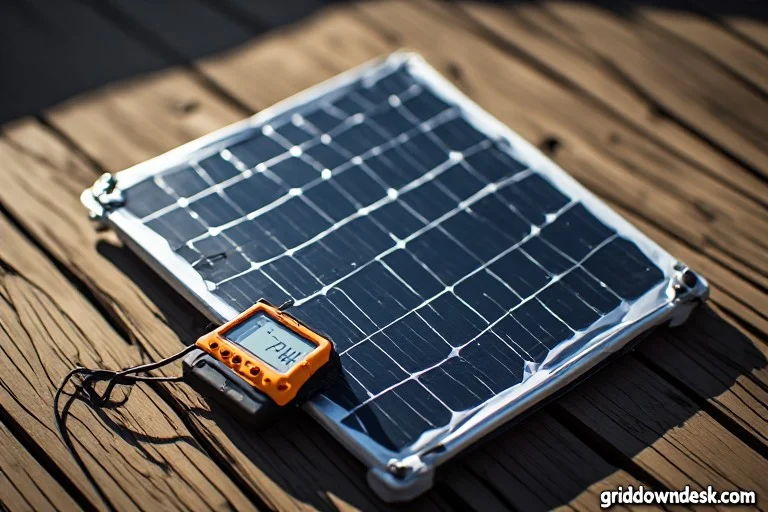
Real-world output breakdown by conditions
Based on empirical testing of monocrystalline foldable panels paired with standard MPPT charge controllers, here is what you can actually expect:
| Condition | Season | Estimated Output (% of Rated) | Real Output (100W Panel) | Real Output (200W Panel) |
|---|---|---|---|---|
| Perfect Summer Noon | Summer | 75% – 80% | 75W – 80W | 150W – 160W |
| Clear Winter Noon | Winter | 50% – 65% | 50W – 65W | 100W – 130W |
| Light Clouds / Haze | Any | 40% – 50% | 40W – 50W | 80W – 100W |
| Heavy Overcast | Any | 10% – 20% | 10W – 20W | 20W – 40W |
| Through a Window | Any | 40% – 50% | 40W – 50W | 80W – 100W |
Note: Solar panels actually become more electrically efficient in cold temperatures. However, the lower angle of the winter sun and shorter daylight hours drastically reduce the total daily energy harvest, outweighing the cold-weather efficiency gain.
Calculating your real daily solar harvest
To avoid disappointment, never use the nominal wattage to calculate charging time. Use the derated real-world wattage. For the foundational math of energy calculations, see our guide on home backup power calculator sizing.
Formula: Daily Harvest (Wh) = (Panel Rated Watts × 0.75) × Peak Sun Hours
Note: "Peak Sun Hours" is not the number of daylight hours. It is the number of hours per day when the sun's intensity averages 1000 W/m². In summer, this might be 5-6 hours. In winter, it may be only 2-3 hours.
Example Calculation (Summer):
- Panel: 200W
- Real-world efficiency factor: 0.75 (200W × 0.75 = 150W actual output).
- Peak Sun Hours: 5 hours.
- Daily Harvest: 150W × 5 hours = 750 Wh per day.
Example Calculation (Winter):
- Panel: 200W
- Real-world efficiency factor: 0.60 (due to low sun angle, 200W × 0.60 = 120W actual output).
- Peak Sun Hours: 2.5 hours.
- Daily Harvest: 120W × 2.5 hours = 300 Wh per day.
As the math shows, winter solar harvesting requires managing expectations and conserving battery power.
Best practices for maximizing solar output
- Chase the sun: A panel lying flat on the ground can lose up to 30% of its potential compared to one angled directly at the sun. Adjust the panel's tilt every few hours to maintain a 90-degree angle to the sun's rays.
- Keep it cool: While counterintuitive, solar panels lose about 0.3% to 0.5% of their efficiency for every degree Celsius above 25°C. Ensure there is airflow under the panel. Do not lay it on hot asphalt or a dark car roof if you can avoid it; elevate it slightly.
- Clean the surface: Dust, pollen, and bird droppings create "shading" on individual cells, which can disproportionately drop the output of the entire panel string. Wipe the surface with a damp microfiber cloth before deployment.
- Bypass partial shading: Even a small shadow from a tree branch or antenna falling on one cell can cut the panel's output by 50% or more. Position the panel in 100% unobstructed sunlight.
Maintaining your solar gear
Foldable solar panels are durable, but their junction boxes and cables are vulnerable. Always coil the cables loosely (never wrap them tightly around the panel, which can degrade internal wires) and store the panel in a dry place. For comprehensive care instructions for the devices you are charging, see our guide on how to maintain and store your portable power station.
FAQ
Can I charge my power station through a glass window? Yes, but with significant losses. Standard window glass blocks a portion of the solar spectrum and causes reflections. Expect a 40% to 50% reduction in output compared to being outdoors. It is better than nothing in an emergency, but highly inefficient for daily charging.
Why does my wattage fluctuate when a cloud passes? MPPT (Maximum Power Point Tracking) controllers constantly adjust the voltage and current to find the optimal power point. When a cloud alters the light intensity, the controller rapidly recalculates, causing the displayed wattage to jump up and down. This is normal and indicates the controller is working correctly.
Do I need a larger solar panel for winter camping? Yes. If you rely on solar to maintain your power station in winter, you should oversize your solar array by 50% to 100% compared to your summer setup to compensate for the low sun angle and short days.
Will snow damage my solar panel? No. Solar panels are designed to withstand heavy snow loads. In fact, a light dusting of snow can reflect additional light onto the panel, slightly boosting output. However, a thick layer of snow will block all light. Gently brush it off with a soft broom to resume charging.