Microwave Power Station Test: Real Wattage & Runtime
Short answer
A microwave labeled as "1000W" refers to its cooking output, not its electrical draw. In reality, due to magnetron inefficiency and power factor, it will draw 1400W to 1600W from the wall. To run it safely, you need a portable power station with a pure sine wave inverter rated for at least 1800W to 2000W continuous output. A 1000Wh power station will provide approximately 30 to 40 minutes of total heating time, which is enough for several short meal preparations during a blackout.
The "Cooking Watts" illusion
The most common reason for a power station overload during a blackout is misinterpreting microwave specifications.
The wattage printed on the front of a microwave (e.g., 700W, 1000W, 1200W) is the microwave energy output delivered to the food. However, the magnetron and high-voltage transformer that generate this energy are only about 60% to 70% efficient. Furthermore, inductive components like transformers have a poor power factor, meaning they draw more apparent power (VA) from the grid than their real power (W) suggests.
Therefore, the actual draw from your power station's inverter is always significantly higher than the advertised cooking wattage.
Real-world wattmeter test results
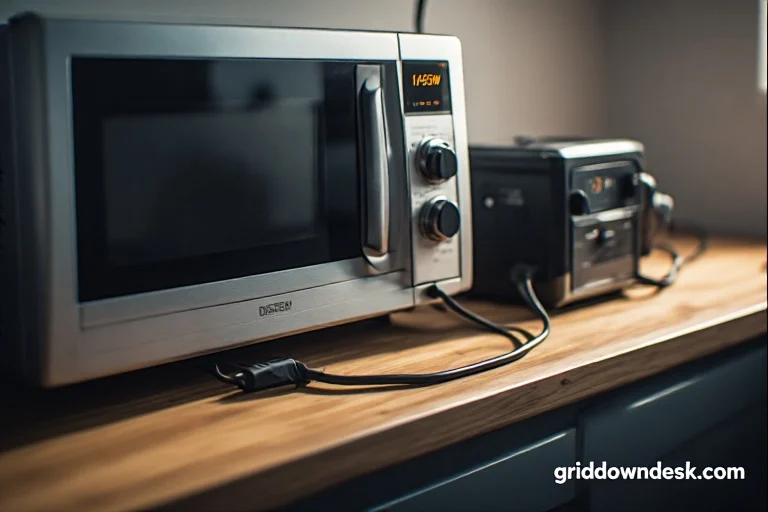
We measured the actual AC power draw of three common microwave sizes using a calibrated inline wattmeter connected to a pure sine wave power source.
| Microwave Label (Output) | Measured Idle Draw | Measured Heating Draw (Peak) | Required Power Station Min. Output |
|---|---|---|---|
| 700W (Compact) | 4W | 1050W – 1150W | 1200W+ |
| 1000W (Standard) | 5W | 1400W – 1550W | 1800W+ |
| 1200W (Large) | 6W | 1650W – 1800W | 2000W+ |
Note: The "Peak" draw occurs the moment the magnetron engages. If your power station's continuous or surge rating is below this number, it will instantly trigger overload protection and shut down.
Calculating your microwave runtime
Unlike a refrigerator that runs continuously, a microwave is used in short, intermittent bursts. Therefore, we calculate capacity in total minutes of heating time, not hours. For the foundational math, see our guide on home backup power calculator sizing.
Total Heating Minutes = (Usable Battery Wh ÷ Actual Draw in Watts) × 60
Example Calculation (Standard 1000W Microwave):
- Actual draw: 1500W.
- Power source: 1000Wh portable power station.
- Usable energy (at 85% inverter efficiency): 1000 × 0.85 = 850 Wh.
- Total heating time: (850 Wh ÷ 1500W) × 60 = ~34 minutes.
While 34 minutes sounds short, it is equivalent to heating 10 to 15 individual meals for 2-3 minutes each, which is highly sufficient for emergency blackout cooking.
The Inverter Microwave advantage
If you are buying a microwave specifically for off-grid or backup use, strongly consider an Inverter Microwave.
Traditional microwaves achieve "50% power" by turning the magnetron fully on and fully off in rapid cycles. This means even at 50% power, it still pulls the massive 1500W peak surge repeatedly. An inverter microwave, however, actually reduces the continuous power delivered to the magnetron. A 1000W inverter microwave set to 50% power will draw a steady, smooth ~750W from the wall, eliminating violent power spikes and allowing you to use a much smaller, lighter power station.
Best practices for blackout microwave use
- Verify Pure Sine Wave: Magnetrons and their high-voltage transformers are highly sensitive to waveform quality. A modified sine wave inverter will cause the microwave to hum loudly, heat inefficiently, and potentially damage the internal components.
- Defrost food first: If possible, thaw frozen food using other methods before using the microwave. Heating already-thawed food requires significantly less time and energy than bringing frozen items up to temperature.
- Use lower power settings wisely: As noted above, this only saves energy if you have an inverter microwave. For standard models, use full power for shorter durations to minimize the number of magnetron startup surges.
- Keep the interior clean: Food splatter inside the microwave cavity absorbs microwave energy, forcing the magnetron to work harder and draw slightly more power to achieve the same heating result.
Maintaining your high-load readiness
Frequently pulling near-maximum wattage from a power station generates significant internal heat. Always ensure the unit's cooling fans are unobstructed and that it is placed in a well-ventilated area during use. For comprehensive battery care instructions, especially after high-drain cycles, see our guide on how to maintain and store your portable power station.
FAQ
Can I use a 1000W power station for a 1000W microwave? No. Because the microwave actually draws ~1500W, it will exceed the 1000W continuous limit of the station, triggering an immediate overload shutdown. You must size the station for the actual draw, not the label.
Why does my power station shut off after 10 seconds of heating? Some power stations have overly sensitive software that interprets the highly inductive, fluctuating load of a microwave magnetron as a short circuit or fault, even if the wattage is technically within limits. This is a known compatibility issue with certain budget power station brands.
Is it better to use a camping propane stove instead of a microwave during a blackout? For boiling water or heating pre-cooked meals, yes. A propane stove uses zero battery power, freeing up your electrical reserves for critical devices like routers, medical equipment, or lighting.
Can I run the microwave and a refrigerator on the same power station? Only if the power station has a very high continuous rating (e.g., 2400W+). If the refrigerator compressor kicks on while the microwave is heating, the combined surge will almost certainly trip the inverter's overload protection.