Gas Furnace Blackout Power Guide
Short answer
Even though it burns gas, a modern forced-air gas furnace requires 120V AC electricity to run its blower motor, inducer fan, and electronic controls. A typical furnace blower draws between 400W and 800W while running. A 1000Wh portable power station with a pure sine wave inverter can keep a standard gas furnace running for approximately 1 to 2.5 hours, depending on the duty cycle and outdoor temperature.
Why gas furnaces fail during blackouts
A common misconception is that gas appliances work perfectly without grid power. While your gas stove burners might light manually, a modern high-efficiency gas furnace is entirely dependent on electricity.
Without power, the electronic control board cannot spark the igniter, the inducer motor cannot vent exhaust gases safely, and the main blower fan cannot push warm air through your ductwork. If the power goes out in the middle of winter, your gas furnace becomes a useless metal box, and your home will rapidly lose heat.
Real-world power consumption breakdown
To size your backup power correctly, you must understand the different stages of a furnace's heating cycle.
Typical power consumption:
- Inducer Motor (Venting): 50W – 100W (runs for a few minutes before ignition).
- Hot Surface Igniter: 200W – 300W (draws high power for only 30-60 seconds to light the gas).
- Main Blower Motor: 400W – 800W (runs continuously while the thermostat calls for heat).
- Total Continuous Running Load: 400W – 800W (once the igniter turns off).
Note: Older, less efficient furnaces with standard PSC motors draw closer to 800W. Newer high-efficiency models with ECM (variable speed) motors are much more efficient, drawing only 100W to 300W once they reach speed.
Calculating the winter runtime
To estimate how long your power station will keep the heat on, we use the standard runtime formula, adjusted for the furnace's duty cycle (how often the blower actually runs). For the base math, see our guide on UPS runtime explained: VA vs watt-hours.
Runtime (hours) = (Battery Capacity in Wh × 0.85) ÷ (Running Watts × Duty Cycle)
Example Calculation:
- You have a 1000Wh portable power station.
- Your furnace blower draws 600W when running.
- During a cold night, the furnace runs 40% of the time (0.40 duty cycle).
- Effective average draw: 600W × 0.40 = 240W.
- Usable energy: 1000 × 0.85 = 850 Wh.
- Runtime: 850 Wh ÷ 240W = ~3.5 hours.
If the temperature drops drastically and the furnace runs 80% of the time, that same 1000Wh station will only last about 1.7 hours.
Critical requirements for furnace backup
- Pure Sine Wave is Mandatory: Furnace control boards and variable-speed ECM motors are highly sensitive to power quality. A modified sine wave inverter will cause the control board to throw error codes, buzz loudly, or permanently damage the motor.
- Surge Capacity: The blower motor requires a brief surge of power to start spinning. Ensure your power station's peak surge rating is at least 1500W to 2000W to handle this initial spike without tripping.
- GFCI Compatibility: Some portable power stations have built-in GFCI (Ground Fault Circuit Interrupter) protection on their AC outlets. Furnace motors can sometimes cause "nuisance tripping" on sensitive GFCI breakers. If your furnace keeps shutting off the power station, you may need to use a standard, non-GFCI heavy-duty extension cord between the station and the furnace.
Strategies to extend your heating runtime
Running a central furnace on battery power is energy-intensive. To stretch your battery life during a multi-day winter blackout, use these proven strategies:
- Zone heating with a space heater: Turn the main thermostat down to 50°F (10°C) to prevent pipes from freezing. Use a small, low-wattage electric blanket or a highly efficient personal heater in the one room where your family spends most of their time. For details on safe space heater usage, see our guide on power station for space heater runtime.
- Seal the house: Close doors to unused rooms, block drafts under exterior doors, and open curtains on the south side of the house during the day to capture passive solar heat.
- Keep the power station warm: Lithium batteries lose capacity in freezing temperatures. Keep your power station inside the heated living space, not in an unheated garage or basement, to ensure it delivers its full rated watt-hours.
Maintaining your winter readiness
A power station is your lifeline during a winter storm, but lithium batteries self-discharge over time. To ensure your unit is ready when the temperature drops, store it indoors at room temperature and check the charge level monthly. For comprehensive battery care instructions, see our guide on how to maintain and store your portable power station.
FAQ
Can I plug my gas furnace directly into a standard home UPS? No. Standard computer UPS units do not have the continuous wattage (400W-800W) or the massive surge capacity required to start a furnace blower motor. They will trip instantly.
Will a power station recharge from solar while running the furnace? No. Even a large 400W solar array will only produce about 300W in ideal winter sun. This is far less than the 240W+ average draw of the furnace. The battery will continue to drain, just at a slightly slower rate.
Can I run my gas fireplace and the central furnace on the same power station? Most modern gas fireplaces with blowers draw 100W to 300W. Yes, you can run both, but you must add their wattages together and ensure your power station's continuous output can handle the combined load (e.g., 600W furnace + 200W fireplace = 800W total).
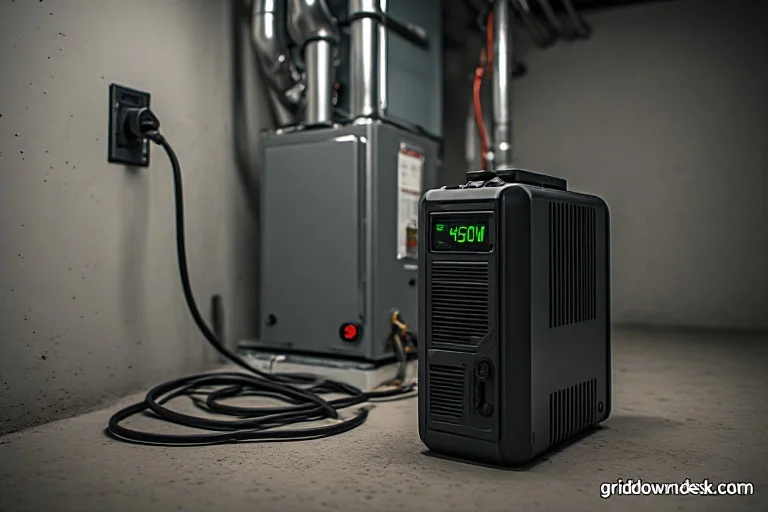
Is it safe to run a power station in the basement with the furnace? Yes. Unlike gas generators, lithium portable power stations produce zero emissions and no carbon monoxide. They are perfectly safe for indoor use, provided they are kept away from standing water and have adequate ventilation for their cooling fans.