Chaining Power Stations: Safe Expansion Guide
Short answer
Yes, you can combine portable power stations to increase capacity, but only using manufacturer-specific DC expansion cables or official expansion batteries. You should never "daisy-chain" stations by plugging one into the AC outlet of another. AC daisy-chaining causes massive energy loss, risks inverter damage due to waveform conflicts, and may trigger overload protections.
The danger of AC "Daisy-Chaining"
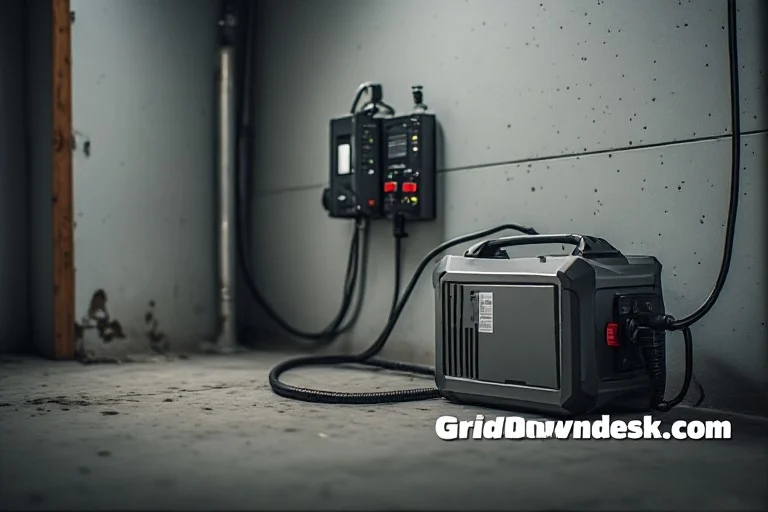
A common misconception is that you can plug Power Station A into the AC wall outlet of Power Station B to "charge it while it runs." This practice, known as daisy-chaining, is highly discouraged for three critical engineering reasons:
- Double Inversion Losses: Power Station B converts its DC battery power to AC. Power Station A then receives that AC and converts it back to DC to charge its battery. Each conversion loses 10-15% of energy as heat. You lose up to 30% of your total capacity to inefficiency.
- Inverter Conflict: If both stations are trying to output AC power to the same load via a splitter, their inverters will "fight." Even a micro-second difference in the sine wave phase or voltage (e.g., 120.1V vs 119.8V) will cause current to flow between the stations instead of to your device, potentially tripping breakers or damaging the electronics.
- Surge Confusion: When a high-draw appliance starts, the sudden load can confuse the charging logic of the "source" station, causing it to mistakenly think there is a short circuit and shut down.
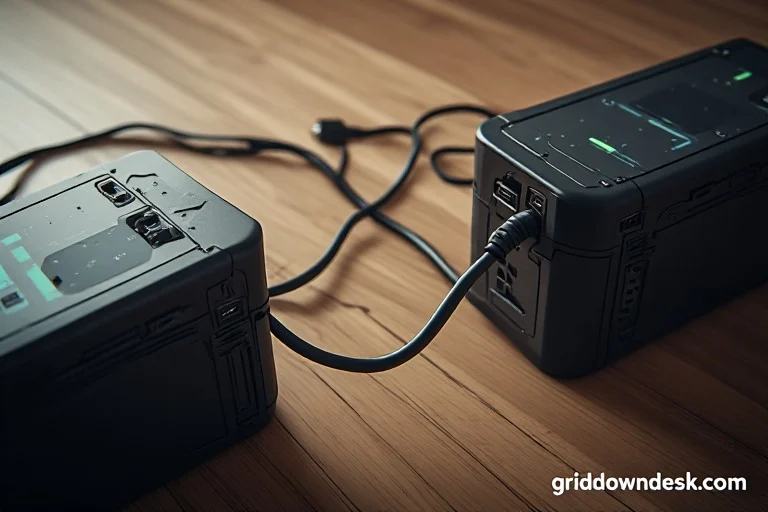
The safe way: DC Expansion Systems
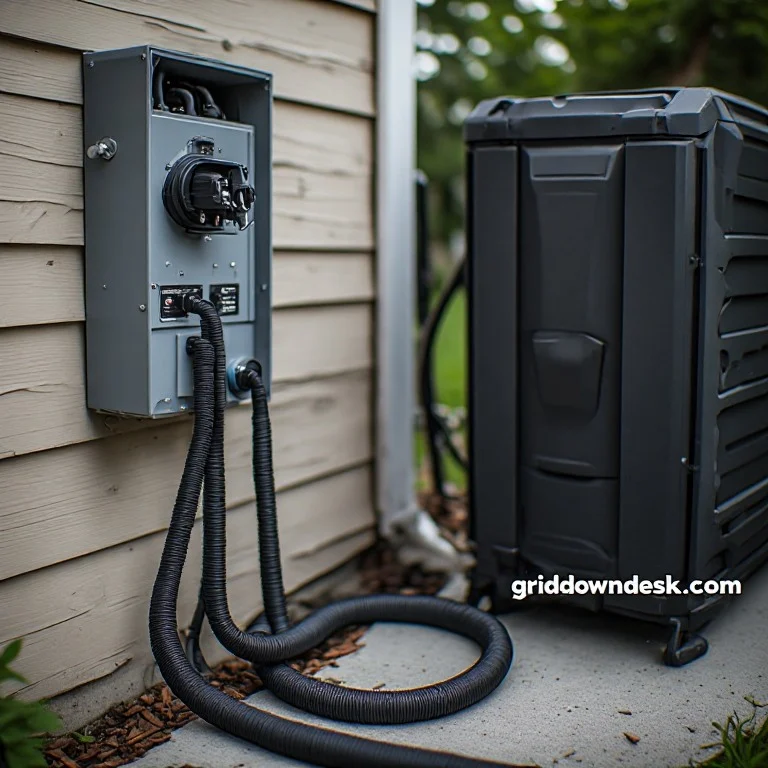
The only correct method to combine power stations is to keep the energy in the Direct Current (DC) domain, managed by a single, unified Battery Management System (BMS).
Major manufacturers (like EcoFlow, Bluetti, and Jackery) offer official expansion batteries. These connect to the main unit via a dedicated, high-amperage DC port.
- How it works: The main unit's BMS sees the expansion battery as a single, larger internal cell block. It manages the charging and discharging seamlessly.
- Efficiency: Because there is no DC-to-AC-to-DC conversion, efficiency remains at 95%+, and the total usable capacity is exactly the sum of both units.
The "Poor Man's Parallel" (And how to do it safely)
If your power station does not support official expansion batteries, you might be tempted to plug two separate stations into a single appliance using a Y-splitter cable. Do not do this with AC power.
However, there is a safe workaround for specific scenarios:
- Separate Loads: Plug the refrigerator into Station A, and the router/lights into Station B. Do not combine their outputs.
- Sequential Swapping: When Station A dies, safely unplug the appliance and plug it into Station B. This requires manual intervention but is 100% safe for the hardware.
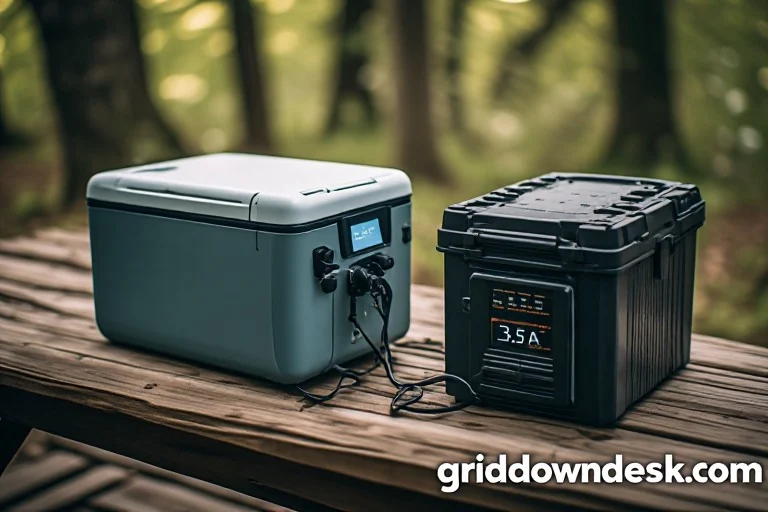
- DC Charging One from Another (With Caution): You can use a 12V car charging cable to plug Station A into the 12V DC output of Station B. This avoids AC inversion losses. However, the 12V port is typically fused at 10A (120W), making the transfer very slow. Ensure the "source" station has a higher charge percentage than the "receiving" station to prevent reverse current flow.
Calculating the true capacity gain
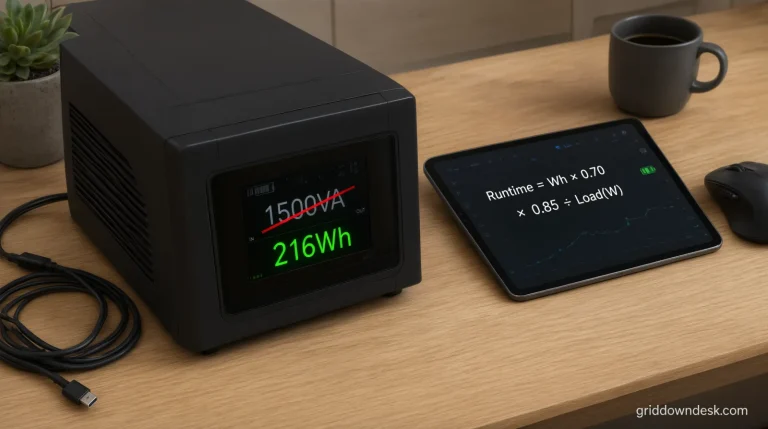
When sizing your backup, remember that adding a second unit does not always perfectly double your runtime if you are using AC loads, due to the baseline power draw of having two inverters running instead of one.
For a detailed breakdown of how to calculate your total home load before buying extra batteries, see our guide on home backup power calculator sizing.
Example:
- Station A (1000Wh) + Station B (1000Wh) = 2000Wh total.
- If connected via official DC expansion, you get the full ~1700Wh of usable energy (at 85% efficiency).
- If daisy-chained via AC, you might only get ~1200Wh of usable energy due to the 30% double-conversion loss.
Best practices for scaling your backup
- Buy matching models: If you plan to expand, buy the expansion battery or a second identical unit from the same brand and generation. Mixing brands or old/new models can lead to BMS communication errors.
- Balance the charge: Before connecting two stations via a DC cable, ensure their battery percentages are within 10% of each other. A large voltage difference can trigger a protective shutdown.
- Monitor heat: Pushing high wattage through expansion cables generates heat. Ensure the cables are not coiled up tightly or covered by rugs, and that the stations have adequate ventilation.
- Maintain your batteries: A larger battery bank requires the same maintenance as a single unit. Check the charge level every 3 to 6 months. For comprehensive battery care instructions, see our guide on how to maintain and store your portable power station.
FAQ
Can I use a standard extension cord to plug two power stations into one power strip? No. This is the definition of dangerous AC daisy-chaining. The inverters will fight, and you risk damaging both units or the appliance.
Will chaining two power stations double the output wattage? No. Connecting two 1000W stations together gives you 2000Wh of capacity (runtime), but the maximum output remains limited to the inverter of the main unit (1000W), unless the manufacturer explicitly supports "parallel output" via a special cable (a rare, advanced feature).
Is it safe to leave expansion batteries connected permanently? Yes. Official expansion systems are designed to be left connected. The main unit's BMS will manage the charge state of the entire bank, keeping all cells balanced and healthy.
What if my power station doesn't have an expansion port? Then it is not designed to be chained. Rely on the "Sequential Swapping" method mentioned above, or upgrade to a model that supports modular expansion when your power needs grow.