Coffee Maker & Power Station: Runtime Guide
Short answer
Yes, a portable power station can easily run a coffee maker or electric kettle, provided its continuous AC output exceeds the appliance's wattage (typically 800W to 1500W). However, because heating elements draw massive, constant power, a 1000Wh power station will only provide about 35 to 45 minutes of total boiling time, which is enough for 4 to 6 cups of coffee or a single large pot.
The reality of resistive loads
Unlike refrigerators or well pumps that have electric motors and massive startup surges, coffee makers and electric kettles are resistive loads. They use simple heating elements to boil water.
This means two things:
- No startup surge: The power draw is perfectly stable from the moment you press "on" to the moment it clicks off. A 1200W kettle draws exactly 1200W continuously.
- High energy consumption: Heating water is one of the most energy-intensive tasks in physics. There are no shortcuts or "efficiency hacks" to reduce the wattage required to bring water to 100°C (212°F).
Real-world power consumption breakdown
To size your power station correctly, check the wattage rating on the bottom of your appliance.
Typical power consumption:
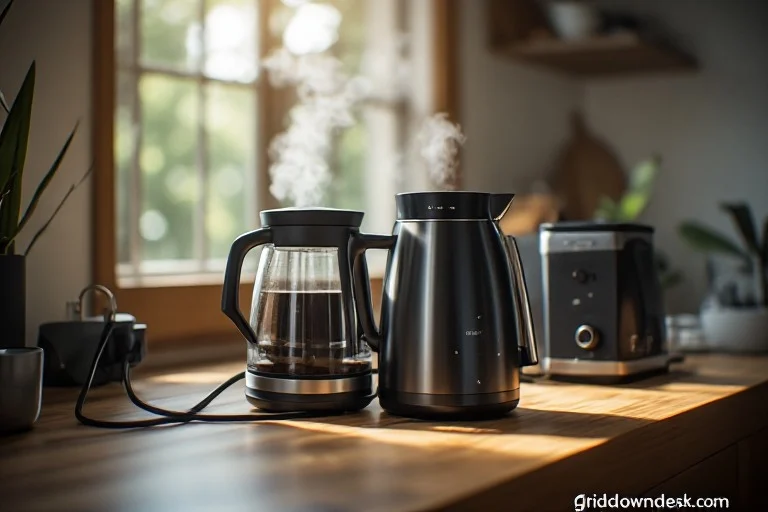
- Standard Drip Coffee Maker: 600W – 900W (draws power only while actively brewing).
- Electric Kettle (1.0 – 1.5 Liter): 1200W – 1500W (draws max power for 3-5 minutes until boiling).
- Single-Serve Pod Machine (e.g., Keurig): 1000W – 1500W (draws high power for 1 minute per cup to flash-heat water).
- Espresso Machine (with boiler): 1000W – 1400W (draws power to heat up, then cycles to maintain temperature).
Calculating your "cups of coffee" runtime
To estimate how many times you can brew, we use the standard runtime formula. For the base math, see our guide on UPS runtime explained: VA vs watt-hours.
Total Boiling Time (hours) = (Battery Capacity in Wh × 0.85) ÷ Appliance Wattage
Note: We use 0.85 for inverter efficiency to account for the energy lost when converting DC battery power to AC.
Example Calculation (Electric Kettle):
- You have a 1000Wh portable power station.
- Your electric kettle draws 1200W.
- Usable energy: 1000 × 0.85 = 850 Wh.
- Total boiling time: 850 Wh ÷ 1200W = 0.70 hours (42 minutes).
If it takes 4 minutes to boil a full kettle, 42 minutes of total runtime equals roughly 10 full kettles. For a single-serve pod machine taking 1 minute per cup, that same battery will yield about 35 to 40 cups.
Strategies to maximize your morning coffee
If you are managing limited battery power during an outage or off-grid trip, use these proven methods to conserve energy:
- Boil only what you need: An electric kettle is far more efficient than a drip coffee maker because it heats a precise amount of water directly, rather than heating a large glass carafe and keeping it warm.
- Pre-heat with alternative methods: If camping, use a propane camp stove or a fire to bring the water to a near-boil, then use a low-wattage immersion heater or your power station just to top it off to a full boil.
- Descale your appliance regularly: Mineral buildup (limescale) on heating elements acts as insulation, forcing the appliance to work longer and draw more total energy to boil the same amount of water.
- Use a French press or pour-over: These manual brewing methods require only hot water, eliminating the need to power a machine's internal pumps or electronics.
For more details on managing high-wattage appliances safely, refer to our guide on power station for space heater runtime, as the principles of high-draw resistive loads are identical.
Maintaining your power station for high loads
Frequently pulling high wattage (1000W+) generates significant internal heat in the power station's inverter. Ensure the device's cooling fans are unobstructed and never cover the unit with a towel or place it in an enclosed cabinet while brewing. For comprehensive battery care instructions, see our guide on how to maintain and store your portable power station.
FAQ
Can I use a modified sine wave inverter for a coffee maker? Yes. Because coffee makers and kettles are simple resistive loads, they do not care about the shape of the AC waveform. A modified sine wave will work perfectly fine and will not damage the heating element.
Will a power station recharge from solar while I'm making coffee? No. A standard 100W solar panel produces about 70W in real-world conditions. This is a fraction of the 1200W the kettle is consuming. The battery will drain rapidly, regardless of solar input.
Can I run a coffee maker and a mini fridge on the same power station? Yes, but you must add their wattages together. A 1200W kettle + a 60W fridge compressor = 1260W. You must ensure your power station's continuous output rating exceeds 1260W (ideally 1500W+ for a safety margin), or it will trip the overload protection.
Why does my power station shut off after 10 minutes of brewing? Some advanced coffee makers have a "keep warm" plate that stays on indefinitely. If left on, it will slowly drain the battery over hours. Always ensure the appliance is fully switched off after brewing.