V2H and V2L: EV as Home Backup Power Guide (2026)
Short answer
In 2026, your electric vehicle (EV) is likely the most powerful and cost-effective backup battery you own. A standard 60 kWh EV battery can power essential home loads (refrigerator, router, gas boiler, lights) for 2 to 3 days. You can utilize this via V2L (Vehicle-to-Load) using a simple adapter for individual appliances, or V2H (Vehicle-to-Home) via a certified bidirectional charger that integrates directly with your home's electrical panel, offering seamless, automated blackout protection.
The "Wheeled Power Station" reality
The paradigm of home backup has shifted. Instead of buying a $10,000+ stationary 20 kWh home battery, millions of homeowners now leverage the 60–100 kWh battery already sitting in their garage.
Modern EVs support advanced communication protocols (like ISO 15118-20), allowing the car's Battery Management System (BMS) to safely negotiate power flow with a bidirectional charger. The round-trip efficiency (DC from car → AC to home → DC to appliances) of modern 2026 V2H chargers has reached 90–92%, making it nearly as efficient as dedicated home battery systems, but at a fraction of the cost per kWh of capacity.
Real-world V2H and V2L power capabilities
The method you choose depends on your vehicle's native capabilities and your budget.
1. V2L (Vehicle-to-Load) – The Plug-and-Play Method
- How it works: An adapter plugs into the car's charge port (or an internal V2L outlet, as seen in Hyundai Ioniq 5/6, Kia EV6, or Ford F-150 Lightning), providing a standard 120V/230V AC outlet.
- Max Output: Typically 1.8 kW to 3.6 kW continuous.
- Best for: Powering a refrigerator, router, and a few lights via a heavy-duty extension cord. No home wiring modifications required.
2. V2H (Vehicle-to-Home) – The Whole-Home Integration
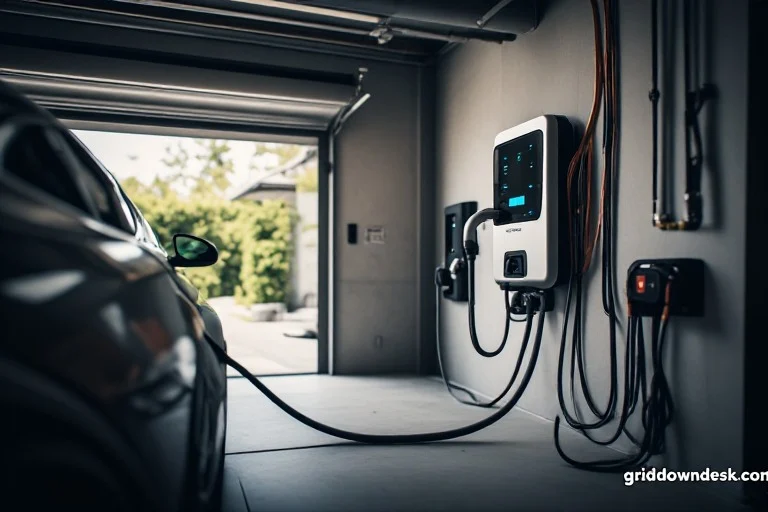
- How it works: A wall-mounted bidirectional charger (e.g., Wallbox Quasar 2, Fermata FE-15, or Ford Charge Station Pro) connects the car to a dedicated sub-panel with an Automatic Transfer Switch (ATS).
- Max Output: 7.2 kW to 11.5 kW continuous (enough to run a well pump, HVAC, and all essential circuits).
- Best for: Seamless, automated backup that feels exactly like grid power.
Calculating your EV backup runtime
To estimate how long your car can keep the house running, we apply a conservative depth of discharge (DoD) to protect the EV's long-term driving range. For foundational load math, see our home backup power calculator sizing guide.
Formula: Runtime (hours) = (EV Battery kWh × Safe DoD × V2H Efficiency) ÷ Average Home Load (kW)
Example Calculation (Modern 60 kWh EV):
- Usable capacity (stopping at 20% to preserve driving range): 60 kWh × 0.80 = 48 kWh.
- Modern V2H round-trip efficiency: 90% (0.90).
- Effective energy: 48 kWh × 0.90 = 43.2 kWh.
- Average essential home load during outage: 1.0 kW (1000W).
- Runtime: 43.2 kWh ÷ 1.0 kW = 43.2 hours (nearly 2 full days).
If you have a larger EV (e.g., 100 kWh), this runtime extends to over 3.5 days on essential loads alone.
Best practices for EV backup integration
- Set a Discharge Limit: Always configure the V2H charger or car settings to stop discharging at 20% or 30% State of Charge (SoC). This guarantees you retain enough range for an emergency evacuation or daily commute.
- Verify Local Grid Codes: V2H installations require a certified bidirectional charger that meets local anti-islanding standards (e.g., UL 1741 SB in North America, or relevant G98/G99 standards in Europe) to prevent backfeeding the grid and endangering utility workers.
- Pre-condition the Cabin on Grid Power: Before a known storm, plug the car in and pre-heat or pre-cool the cabin using grid power. This saves the EV's battery for actual home loads during the outage.
- Understand V2L Limitations: If using V2L, do not exceed the adapter's rated amperage. Plugging a 1500W space heater into a 1.8 kW V2L outlet leaves almost no headroom for a refrigerator compressor surge, which will trip the car's internal breaker.
Maintaining your EV backup readiness
Using an EV for daily V2H cycling has a minimal impact on modern battery degradation (typically less than 1-2% additional capacity loss per year, according to 2026 fleet data), provided the battery is not frequently drained to 0% or left at 100% in extreme heat. For general principles of maximizing lithium-ion lifespan, see our guide on how to maintain and store your portable power station, as the core chemistry care rules remain identical.
FAQ
Will using V2H void my EV battery warranty? No, as long as you use a certified, manufacturer-approved bidirectional charger and stay within the vehicle's specified V2H parameters. Major automakers now explicitly support and warranty this functionality.
Can I use a standard EV charger for V2H? No. Standard Level 2 chargers are unidirectional (grid-to-car only). You must install a specific bidirectional (V2H) charger, which is currently more expensive but acts as both a charger and a whole-home inverter.
What happens if the grid comes back on while the car is discharging? A properly installed V2H system with an ATS will detect the grid's return, seamlessly pause the discharge, and automatically switch the home back to grid power. The car will then resume normal charging if needed.
Is V2L safe to use in the rain? Yes. V2L adapters and vehicle charge ports are designed with the same IP67 weatherproofing standards as the charging port itself. However, the connected appliances and extension cords must be rated for outdoor/wet use.