Compressor vs Thermoelectric Cooler Power Test
Short answer
In real-world testing, a 12V compressor portable fridge consumes 20Wh to 40Wh per day, while a thermoelectric cooler consumes 400Wh to 800Wh per day. For any scenario involving battery backup, camping, or off-grid living, a compressor fridge is the only viable option. A thermoelectric cooler will drain a standard 500Wh power station in less than 12 hours, whereas a compressor fridge will run for over 10 days on the same battery.
The thermoelectric myth
Thermoelectric coolers (often marketed as "12V car fridges") are incredibly popular due to their low upfront cost. However, they are fundamentally misunderstood. They do not contain a compressor or refrigerant. Instead, they use the Peltier effect: an electrical current is passed through a semiconductor junction, moving heat from one side to the other.
The critical flaw? A thermoelectric cooler must run 100% of the time to maintain any temperature difference. It cannot "cycle off." Furthermore, its cooling capacity is relative to the ambient temperature. If it is 90°F (32°C) outside, a thermoelectric cooler can only cool its contents to about 40°F-50°F (22°C-27°C) below that ambient temperature, meaning your food will still be at 50°F (10°C) while the device relentlessly drains your battery at 40-60 Watts, 24 hours a day.
Real-world power consumption breakdown
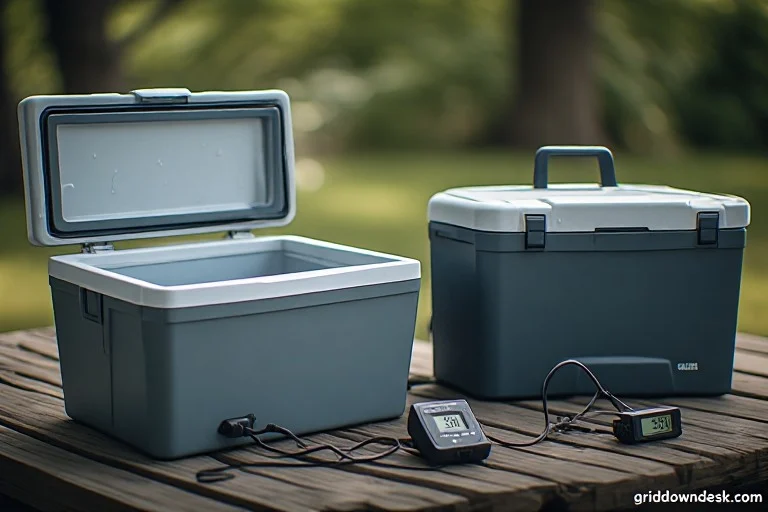
We measured the actual draw of both technologies in a controlled 75°F (24°C) environment, maintaining an internal temperature of 38°F (3°C).
| Feature | 35L Compressor Fridge | 24L Thermoelectric Cooler |
|---|---|---|
| Startup Surge | 45W (for 2 seconds) | None (steady draw) |
| Running Wattage | 45W (while compressor is on) | 45W – 60W (continuous) |
| Duty Cycle | 15% – 25% (cycles on/off) | 100% (never turns off) |
| Average Daily Consumption | 20Wh – 40Wh per day | 480Wh – 720Wh per day |
| Min. Achievable Temp | -4°F (-20°C) | ~50°F (10°C) in warm weather |
Note: The compressor's duty cycle increases in hotter environments, but even at a 50% duty cycle in extreme heat, it only draws ~250Wh per day, still vastly outperforming thermoelectric.
Calculating the battery runtime
To see the dramatic difference in action, we apply the standard runtime formula. For the foundational math, see our guide on home backup power calculator sizing.
Runtime (hours) = (Battery Capacity in Wh × 0.90) ÷ Average Daily Draw (W) (We use 0.90 efficiency because both devices run on 12V DC, bypassing the AC inverter entirely).
Scenario: A 500Wh Portable Power Station
- Compressor Fridge (30Wh/day average):
(500 × 0.90) ÷ (30Wh ÷ 24h) = ~360 hours (15 days).
- Thermoelectric Cooler (500Wh/day average):
(500 × 0.90) ÷ (500Wh ÷ 24h) = ~21.6 hours (less than 1 day).
The math is undeniable. The thermoelectric cooler is essentially a battery-draining heater that happens to keep food slightly cooler than room temperature.
Best practices for off-grid cooling
If you are investing in a compressor fridge for camping or blackout prep, follow these rules to maximize its legendary efficiency:
- Pre-chill at home: Plug the compressor fridge into wall power 12 hours before your trip and load it with pre-chilled food and drinks. This prevents the compressor from working overtime to cool warm items in the field.
- Use block ice or frozen water jugs: These act as "thermal mass." They keep the internal temperature stable, drastically reducing the compressor's duty cycle. As they melt, you have cold drinking water.
- Minimize opening the lid: Every time you open the lid, cold air (which is heavy) spills out, and warm air rushes in. Plan your retrieval of items to keep the lid open for no more than 5-10 seconds.
- Keep it out of direct sunlight: Park your vehicle or position your tent so the fridge is in the shade. A 10°F drop in ambient temperature can reduce the compressor's duty cycle by up to 20%.
Maintaining your cooling setup
Compressor fridges are highly reliable, but their electronic control boards are sensitive to voltage fluctuations. Always use a high-quality 12V cable with proper gauge thickness. Additionally, if you are storing the fridge for the off-season, ensure the portable power station you use to test it is properly maintained. For comprehensive battery care instructions, see our guide on how to maintain and store your portable power station.
FAQ
Can I make a thermoelectric cooler more efficient? No. The laws of thermodynamics dictate the Peltier effect's efficiency. You can insulate the outside of the cooler with reflective foam to slightly reduce the workload, but it will still run 100% of the time and consume massive amounts of power compared to a compressor.
Why does my compressor fridge beep and shut off? This is the "Low Voltage Cutoff" (LVC) feature protecting your vehicle's starter battery or portable power station from being drained to 0%. You can usually adjust the LVC threshold (Low, Medium, High) in the fridge's control panel. Set it to "Medium" for portable power stations.
Are 12V compressor fridges safe to run overnight in a tent? Yes. They produce no carbon monoxide or fumes. The only byproduct is a small amount of heat from the compressor vent and the quiet hum of the motor, which is significantly quieter than a traditional camping generator.
Can I power a compressor fridge with a standard power bank? Yes, but only if you use a specialized "USB-C to 12V/24V DC trigger cable" and the power bank supports high-wattage USB-C Power Delivery (PD) output (at least 45W-60W). This is a popular lightweight setup for backpackers, though a dedicated portable power station is more robust for car camping.